
Category: Fantasy
Inkspell by Cornelia Funke
 (Cover picture courtesy of Tower Books.)
A year has passed, but not a day goes by without Meggie thinking of Inkheart, the book whose characters came to life. For the fire-eater Dustfinger, the need to return to the tale has become more desperate. When he finds a crooked storyteller to read him back, he abandons his apprentice Farid and plunges into the pages. Before long, Farid and Meggie are caught inside the book, too. But the story is much changed—and threatening to end tragically.
This may just be me, but I liked Inkspell more than I liked Inkheart. Meggie and Farid journey to the Inkworld, where the villain of the last novel, Capricorn, was originally from. The romance between the two develops at a natural pace as they try to navigate the quasi-Medieval world that has hidden dangers lurking around every corner. The plot is fairly fast-paced and Cornelia Funke’s character development is second only to her wonderful world-building.
Unlike a lot of fantasy writers, Cornelia Funke does not use creatures exclusively from Norse mythology. Fire elves, White women and brownies populate the Inkworld and enchant readers who are used to the normal fantasy clichés. Of course there are taverns, castles and farms (but what fantasy universe doesn’t have these?), but they do not seem out of place with the rest of the world because it is very well developed.
Cornelia Funke is really an excellent writer and Anthea Bell, who translated it from the original German, certainly deserves a lot of credit. Translating a book and still keeping the author’s original subtleties is incredibly hard to do. Most translations make the English version a choppy, poorly written book, yet the writing is still very consistent throughout the novel.
I give this book 5/5 stars.
The Magician by Michael Scott
 (Cover picture courtesy of Michael Scott’s website.)
California:
In the hands of Dr. John Dee and the Dark Elders, the book of Abraham the Mage could mean the destruction of the world as we know it. The most powerful book of all time, it holds the secret of eternal life—a secret more dangerous than any one man should ever possess. And Dee is two pages away from the knowledge that would bring the Dark Elders into ultimate power.
His only obstacle? Josh and Sophie Newman—who are eight thousand miles away.
Paris:
After fleeing Ojai, Nicholas, Sophie, Josh, and Scatty emerge in Paris. The City of Light. Home to Nicholas Flamel. Only, this homecoming is anything but sweet.
Niccoló Machiavelli, immortal author and celebrated art collector, lives in Paris and is working for Dee. He’s in hot pursuit, and time is running out for Nicholas and Perenelle. Every day they spend without the book, they age one year: their magic becomes weaker and their bodies more frail. For Flamel, the Prophecy is clearer and clearer. It’s time for Sophie to learn the second elemental magic.
Fire magic.
And there’s only one man who can teach it to her: Flamel’s old student the Comte de Saint-Germain—alchemist, magician, and rock star.
Josh and Sophie Newman are the world’s only hope. If they don’t turn on each other first.
The Magician is a great second book in The Secrets of the Immortal Nicholas Flamel series, with its fast-paced plot, new and more terrifying creatures and amazing characterization. It’s actually one of the rare second books that I like better than the first book.
Michael Scott continues his amazing characterization by introducing new and far more interesting characters like the Comte de Saint-Germain, Joan of Arc and the infamous Niccoló Machiavelli. Sophie and Josh are given much more depth as Sophie learns new magic and as Josh grows more jealous of his Awakened twin. We also learn more about Nicholas Flamel, Scatty and Dr. John Dee, who is one of my favourite characters, aside from Machiavelli.
What I love most about The Magician is that Michael Scott does not neglect his villains. Dee and Machiavelli are very interesting and are given realistic motivations for following the Dark Elders. They also think they are doing the right thing, which is better than your typical YA villain that thinks they truly are a villain.
By far the best thing about Michael Scott’s writing is that he blends mythology and legends from many cultures together. We meet Mars from Roman mythology, Nidhgg and the Valkyries from Norse Mythology and even Dagon from John Milton’s Paradise Lost. I love mythology, but even people with no prior interest in it will love The Magician.
I give this book 4/5 stars.
Eldest by Christopher Paolini
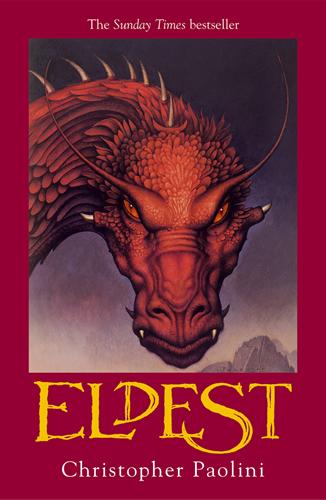 (Cover picture courtesy of Gil T.’s Pleasures.)
Darkness falls…
Swords clash…
Evil reigns.
Eragon and his dragon Saphira, have just saved the rebel state from destruction by the mighty forces of King Galbatorix, cruel ruler of the Empire. Now Eragon must travel to Ellesméra, land of the elves, for further training in magic and swordsmanship, the vital skills of the Dragon Rider. It is the journey of a lifetime, filled with awe-inspiring new places and people, each day a fresh adventure. But chaos and betrayal plague him at every turn and Eragon isn’t sure whom he can trust.
Meanwhile, his cousin Roran must fight a new battle back home in Carvahall—one that puts Eragon in even graver danger.
Will the king’s dark hand strangle all resistance? Eragon may not escape with even his life.
Oh dear, where do I begin with this book?
First, let’s start with the many clichés, shall we? The farm boy with secret powers/a special destiny is already as old as dirt, but what really annoys me is all of the races in Christopher Paolini’s world. The elves are fair, powerful and are forest-dwelling agnostics/atheists. The dwarves are shot, good stonemasons and are mountain-dwelling polytheists. What bothers me is not the religion (which is a mark of good world-building), but the fact that these elves and dwarves are exactly the same as all of the other elves and dwarves in high fantasy. They’re all based off elves and dwarves in Norse mythology, which is fine, but I’d like to see a bit more variety. Why not use races from African or Asian mythologies?
Second, the plot drags on and on, rotating between Eragon and Roran. This would be okay if either character was sufficiently developed so they could hold my attention for more than a page. But they aren’t, which makes the changes seem like head-hopping. The entire plot of Eldest is pretty much Eragon travelling to or spending time with the elves and Roran pulling a Julius Caesar. Of course, Paolini adds in a quick battle at the end with a ‘plot twist’ most Star Wars fans could see coming a mile away. Roran and all of Carvahall come in one ship and completely turn the tide of the battle, which almost—but not quite—a Deus ex Machina.
Third, Paolini still uses way too much description. I love vivid imagery, but my patience (and attention span) has a limit. If Eldest had been written by someone like Conn Iggulden or Michael Scott, who have just the right amount of description, it would have been pared down to less than 300 pages.
I give this book 1/5 stars.
Fire by Kristin Cashore
 (Cover picture courtesy of Goodreads.)
It is not a peaceful time in the Dells. Young King Nash clings to the throne, while rebel lords, in the north and south, build armies to unseat him. War is coming. The mountains and forests are filled with spies and thieves.
This is where Fire lives, a girl whose startling appearance is impossibly irresistible and who can control the minds of everyone around her.
Everyone…except Prince Brigan.
Fire is sort of a prequel to Graceling, but it does not connect the two novels until the end. If you read Fire before reading Graceling, you won’t miss a thing, which is the beauty of Kristin Cashore’s series.
As I said in my review of Graceling, Kristin Cashore has a wonderful way with world-building. Aspiring writers of all types (and some professionally published authors) need to reader her work and take notes on it because her fantasy world sits on a pedestal in YA fiction. The Dells, where the main character Fire lives, is an alien world full of both light and darkness, with strange monsters that are unlike any I’ve seen before. I would read this book for the world-building alone.
But the world-building is certainly not the only reason to read this novel; the character development is right up there. Fire is a strong protagonist in the beginning, yet she still changes for the better by the end of the novel in a wonderful character arc. Her romance with Prince Brigan is unforced and develops slowly, making it all the more authentic. Fire is probably one of my favourite protagonists in the entire YA genre.
The plot of Fire twists and turns, throwing new and unexpected hurdles at the characters. It starts out slow, but the tension slowly ratchets up as Fire’s love for Prince Brigan grows. By the climax, you will be unable to put this book down.
I give this book 5/5 stars.
Artemis Fowl by Eoin Colfer
 (Cover picture courtesy of TweenCity.)
Stay back, human. You don’t know what you’re dealing with.
Twelve-year-old Artemis Fowl is a millionaire, a genius—and, above all, a criminal mastermind. But even Artemis doesn’t know what he’s taken on when he kidnaps a fairy, Captain Holly Short of the LEPrecon Unit. These aren’t the fairies of bedtime stories—they’re dangerous! Full of unexpected twists and turns, Artemis Fowl is a riveting, magical adventure.
Artemis Fowl may be a twelve-year-old criminal mastermind, but readers of all ages will be able to identify with him. He can be cold and ruthless, but we see hints of the boy inside when he is with his mentally ill mother or thinking of his father, who has been missing for over a year. And while he may be a genius, he is flawed and does make a mistake that almost ends his fairy ransoming scheme.
Eoin Colfer’s amazing characterization is second only to his world-building. He has created a compelling history of fairies by mixing folklore with his own highly creative ideas. The technology described in Artemis Fowl is highly futuristic and some of it expands upon older ideas in science fiction. The Neutrino 2000, a laser gun is just one example of this. His explanation for the origin of the word ‘leprechaun’ is also slightly humourous.
Spectacular characters, fantastic world-building and a riveting plot…what more can YA readers ask for? Artemis Fowl certainly deserves to be among the YA greats, therefore I would recommend it to both tweens and teens.
I give this book 5/5 stars.