
Category: Book Review
Scroll of Saqqara by Pauline Gedge
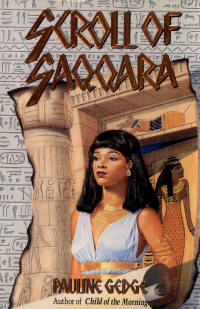 (Cover picture courtesy of Pauline Gedge’s website.)
Prince Khaemwaset is a powerful man. The son of Ramses II and a revered physician, he is respected for his wisdom throughout Egypt. But Khaemwaset harbours a strong and secret desire—to find the mysterious Scroll of Thoth and receive the power to raise the dead.
When Khaemwaset hears of the discovery of a hidden tomb on the plain of Saqqara, he is quick to break its seal and take its secrets—secrets that he soon learns he should never have disturbed.
Richly detailed with the exotic realities of Ancient Egypt, Scroll of Saqqara is a compelling tale of power, lust, and obsession.
Scroll of Saqqara is one of the few novels that has truly managed to surprise me. I thought it was going to be another slow-paced novel that chronicles the life of a famous ancient Egyptian, but I was very, very wrong. Scroll of Saqqara is a relatively fast-paced novel that chronicles the life of a virtually unknown (and fairly unimportant) son of Ramses the Great.
It starts out with Khaemwaset inspecting a tomb that he has ordered opened. The strange thing is that he himself has been digging in the sacred hills of Saqqara—a resting place for the dead that was already ancient in his time—looking for the Scroll of Thoth. It is Khaemwaset’s obsession with finding this legendary scroll that will bring a curse on him and his family.
Scroll of Saqqara is an historical fiction novel, but it could also be categorized as a horror novel because of the tense undercurrent running throughout it (especially in the last 200 pages). Pauline Gedge brings all of her characters to life, especially Ramses, who makes a brief, but memorable appearance. Each character is very well developed and readers will understand them, if not completely sympathize with them. Because of its sexual content, I would recommend Scroll of Saqqara for older teens and adults.
I give this book 4.5/5 stars.
City of Ashes by Cassandra Clare
 (Cover picture courtesy of Gripped Into Books.)
A murderer is loose in New York City…
…and the victims are Downworlder children. Clary Fray and her fellow Shadowhunters have a strong suspicion that Valentine, Clary’s father, may be behind the killings. But if he is the murderer, what’s his true motive? To make matters worse, the second of the Mortal Instruments, the Soul-Sword, has been stolen, and the mysterious Inquisitor ahs arrived to investigate, with his eyes vigilantly targeted on Clary’s brother, Jace.
Clary will need to face some terrifying demons and even more terrifying family decisions. No one said that the life of a Shadowhunter would be easy.
It’s rare that the second book in a series or trilogy is better than the first book (see Catching Fire), but Cassandra Clare has managed to pull it off. City of Ashes has twice the suspense, romance and surprises of City of Bones.
It has many of the clichés of the first novel, but these are given some interesting spins that kept me on the edge of my seat (especially in Chapter 9: And Death Shall Have No Dominion) up until the very end. City of Ashes may be my favourite book in The Mortal Instruments trilogy, but it does have its flaws. Clary could still be substituted for any YA protagonist and Jace is still the stereotypical super hot but icy love interest. The only redeeming thing is that we get to see many other characters’ points of view, which gives them a bit more depth than in the first book.
We see a bit more of Valentine, which I really like. Many of the villains in YA fiction are neglected and end up having what I like to call Dr. No Syndrome: they’re just evil with no explanation or the explanation is really unbelievable. No one really thinks of themselves as a villain in real life, so why should it be any different in fiction? Valentine really thinks he’s doing the right thing and the perverted logic he uses makes it sound like he is the true hero, even if his actions do not match up. I think many YA authors would do well to study Cassandra Clare’s enigmatic villain.
I give this book 4/5 stars.
Fire by Kristin Cashore
 (Cover picture courtesy of Goodreads.)
It is not a peaceful time in the Dells. Young King Nash clings to the throne, while rebel lords, in the north and south, build armies to unseat him. War is coming. The mountains and forests are filled with spies and thieves.
This is where Fire lives, a girl whose startling appearance is impossibly irresistible and who can control the minds of everyone around her.
Everyone…except Prince Brigan.
Fire is sort of a prequel to Graceling, but it does not connect the two novels until the end. If you read Fire before reading Graceling, you won’t miss a thing, which is the beauty of Kristin Cashore’s series.
As I said in my review of Graceling, Kristin Cashore has a wonderful way with world-building. Aspiring writers of all types (and some professionally published authors) need to reader her work and take notes on it because her fantasy world sits on a pedestal in YA fiction. The Dells, where the main character Fire lives, is an alien world full of both light and darkness, with strange monsters that are unlike any I’ve seen before. I would read this book for the world-building alone.
But the world-building is certainly not the only reason to read this novel; the character development is right up there. Fire is a strong protagonist in the beginning, yet she still changes for the better by the end of the novel in a wonderful character arc. Her romance with Prince Brigan is unforced and develops slowly, making it all the more authentic. Fire is probably one of my favourite protagonists in the entire YA genre.
The plot of Fire twists and turns, throwing new and unexpected hurdles at the characters. It starts out slow, but the tension slowly ratchets up as Fire’s love for Prince Brigan grows. By the climax, you will be unable to put this book down.
I give this book 5/5 stars.
Mockingjay by Suzanne Collins
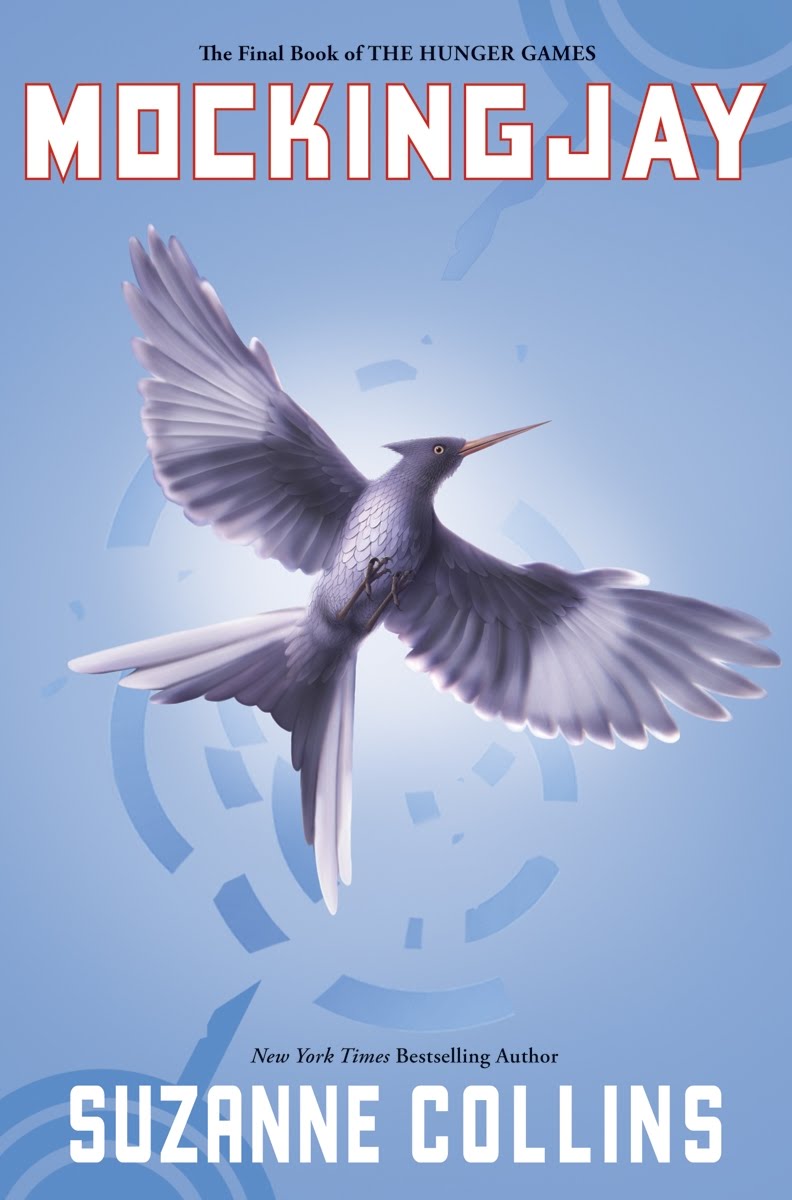 (Cover picture courtesy of The Book Smugglers.)
Katniss Everdeen, girl on fire, has survived, even through her home has been destroyed. Gale has escaped. Katniss’s family is safe. Peeta has been captured by the Capitol. District 13 really does exist. There are rebels. There are new leaders. A revolution is unfolding.
It is by design that Katniss was rescued from the arena in the cruel and haunting Quarter Quell, and it is by design that she has long been part of the revolution without knowing it. District 13 has come out of the shadows and is plotting to overthrow the Capitol. Everyone, it seems, has had a hand in the carefully laid plans—except Katniss.
The success of the rebellion hinges on Katniss’s willingness to be a pawn, to accept responsibility for countless lives, and to change the course of the future of Panem. To do this, she must put aside her feelings of anger and distrust. She must become the rebels’ Mockingjay—no matter what the personal cost.
I loved the Hunger Games trilogy up until this last book. I wish it could have ended better, but it didn’t.
In Mockingjay, Katniss has transitioned from a strong, independent-minded protagonist to an annoying, whiny narrator. All she really does throughout the novel is watch District 13 fight the Capitol and moan about how they’re using her as their symbol. She dodges training sessions, which explains why the rebels are annoyed at her all of the time. Katniss also angsts about how the rebels are using her, which I find annoying. If you’re trying to overthrow an evil empire, which is more important: your independence or winning the war? And if it takes being used to win, isn’t that worth it?
This might just be me, but I found the ending rather disappointing. As if to demonstrate the total senselessness of war, Suzanne Collins kills of 90% of the characters we meet. I can understand some deaths (after all, it is a war), but I don’t like how she killed off almost everyone, then wrote a ‘happy’ epilogue to stop her readers from tearing her to shreds. To me, it’s reminiscent of how JK Rowling ended the Harry Potter series, then wrote a poorly-written hurried epilogue to placate her readers.
In some ways, I wish The Hunger Games had been a stand-alone novel. What do you think? Were you satisfied with the ending? Or did it feel forced? Please tell me in the comments below.
I give this book 2/5 stars.
Catching Fire by Suzanne Collins
 (Cover picture courtesy of Suzanne Collin’s website.)
Against all odds, Katniss has won the Hunger Games. She and fellow District 12 tribute Peeta Mellark are miraculously still alive. Katniss should be relieved, happy even. After all, she has returned to her family and her longtime friend Gale. Yet nothing is as Katniss wishes it to be. Gale holds her at an icy distance. Peeta has turned his back on her completely. And there are whispers of a rebellion against the Capitol—a rebellion that Katniss and Peeta may have helped create.
Much to her shock, Katniss has fueled an unrest she’s afraid she cannot stop. And what scares her even more is that she’s not entirely convinced she should try. As time draws near for Katniss and Peeta to visit the districts on the Capitol’s cruel Victory Tour, the stakes are higher than ever. If they can’t prove, without a shadow of a doubt, that they are lost in their love for each other the consequences will be horrifying.
In Catching Fire, the second novel of the Hunger Games trilogy, Suzanne Collins continues the story of Katniss Everdeen, testing her more than ever before…and surprising readers at every turn.
Catching Fire is the second book in the Hunger Games trilogy, and, like most second books, it is not nearly as good as the first book. Don’t get me wrong—Catching Fire is still a decent novel in its own right. But in the context of the series, it is not as good as the first book.
In Catching Fire, Suzanne Collins has broken her own rules (although there is a good reason for it) and centred it on the worst aspect of the first book: the romance. Throughout the novel, Katniss seems to grow more found of Peeta, but she is hot and cold about it. One minute, she ‘loves’ him, the next she hates him. I understand that his happens in real life, but fiction is supposed to make sense and being stuck in Katniss’s point of view makes it very frustrating.
Katniss was a very strong female protagonist in The Hunger Games—and she still is in Catching Fire—but she does not change very much throughout the course of the novel. The other characters like Peeta and Haymitch do get more backstory and change a bit, but Katniss remains static. There is, however, a significant amount of development in Finnick, a minor character who suddenly gets a very interesting backstory. If only Suzanne Collins had developed Katniss like she developed her minor characters in this novel.
I give this book 3/5 stars.