
Category: Science Fiction
There Comes a Prophet by David Litwack
 (Cover picture courtesy of Goodreads.)
A world kept peaceful for a thousand years by the magic of the ruling vicars. But a threat lurks from a violent past. Wizards from the darkness have hidden their sorcery in a place called the keep and left a trail of clues that have never been solved.
Nathaniel has grown up longing for more but unwilling to challenge the vicars. Until his friend Thomas is taken for a teaching, the mysterious coming-of-age ritual. Thomas returns but with his dreams ripped away. When Orah is taken next, Nathaniel tries to rescue her and ends up in the prisons of Temple City. There he meets the first keeper of the ancient clues. But when he seeks the keep, what he finds is not magic at all.
If he reveals the truth, the words of the book of light might come to pass:
“If there comes among you a prophet saying ‘Let us return to the darkness,’ you shall stone him, because he has sought to thrust you away from the light.”
[Full disclsoure: David Litwack sent me a print book in exchange for an honest review.]
There Comes a Prophet was definitely not what I expected—in a good way! In what seems to be epic fantasy in the beginning, I expected your typical coming of age story: young hero is reluctantly thrust into a war between two races because his mentor is killed/powers are discovered and ends up saving the world after a long and arduous journey. The reality of David Litwack’s science fiction/fantasy was so far from my prediction that I feel quite foolish now. No, instead of a young hero there are three young friends who don’t seek to rebel against the vicars in the beginning. But then something happens that changes Thomas and Nathaniel must bargain away his freedom in order to save Orah from the same fate.
Nathaniel’s completely selfless bargain is the catalyst for the three friends’ journey and along the way, they encounter people who can see the vicars for what they really are. And what they find at the ‘end’ of their epic journey changes them and their world forever, but not in the instantaneous rebellion way you would expect. David Litwack certainly isn’t an author that falls into the cliché trap and he has realized that societies don’t suddenly change overnight. The ending has a wonderful plot twist and my favourite part is that not everything is resolved yet the ending is satisfying. A surprising number of authors can’t pull this off, but David Litwack has.
My favourite part of There Comes a Prophet was the world-building. The rise of the Temple, the fall of technology and the change back to the old ways is a fascinating story. The information is parceled out in small chunks throughout the novel, so it doesn’t feel like an info-dump at all. Some of the dialogue was a little stiff (even for fantasy), but it didn’t detract from the overall quality of the novel.
I give this book 4.5/5 stars.
Scarlet by Marissa Meyer
 (Cover picture courtesy of Goodreads.)
The fates of Cinder and Scarlet collide as a Lunar threat spreads across the Earth…
Cinder, the cyborg mechanic, returns in the second thrilling installment of the bestselling Lunar Chronicles. She’s trying to break out of prison—even though if she succeeds, she’ll be the Commonwealth’s most wanted fugitive.
Halfway around the world, Scarlet Benoit’s grandmother is missing. It turns out there are many things Scarlet doesn’t know about her grandmother or the grave danger she has lived in her whole life. When Scarlet encounters Wolf, a street fighter who may have information as to her grandmother’s whereabouts, she is loath to trust this stranger, but is inexplicably drawn to him, and he to her. As Scarlet and Wolf unravel one mystery, they encounter another when they meet Cinder. Now, all of them must stay one step ahead of the vicious Lunar Queen Levana, who will do anything for the handsome Prince Kai to become her husband, her king, her prisoner.
Scarlet is pretty much everything you’d expect from Marissa Meyer: fast-paced, lots of plot twists, great characters and a seamless blending of fairytale and science fiction. With that said, it’s still not as good as Cinder.
I’ll start with the new characters: Scarlet and Wolf. Scarlet is a pretty good character and goes through an interesting character arc throughout her travels with Wolf. I wouldn’t say she stands among the legions of amazingly memorable characters like Claudius, Katniss, Marco or Ish, but she certainly isn’t a Mary Sue. Personally, I liked Wolf much better than Scarlet because he had a lot more depth. At first he’s your tortured, brooding streetfighter, but as the book goes on, we get introduced to his background and see Wolf change both through his actions and words. Cinder, of course, is still as resourceful and intelligent as ever; I have no complaints about her.
The plot is pretty fast-paced, but Marissa Meyer makes sure that she inserts a little bit of backstory to remind readers of the events of Cinder. This was especially helpful for me since I haven’t read Cinder in nearly a year. So, memory jogged, readers will move along quickly and discover lots of incredible plot twists along the way. Red herrings, betrayal, escape…just about everything a good plot requires. Scarlet also ends on an interesting enough cliffhanger that I want Cress right now. Unfortunately it isn’t out until 2014, but apparently it features Rapunzel.
Much like Cinder, Scarlet carefully blends the tale of Little Red Riding Hood and the Big Bad Wolf into a science fiction narrative. It doesn’t really feel contrived either, so the growing connection between Scarlet and Wolf was satisfying for me. However, the reason I don’t like Scarlet as much as the first book is that it seemed to lack heart. Marissa Meyer had great characters, a great plot, her usual great world-building, but there wasn’t that oomph that was present in Cinder. Overall, it was a good story, but I wouldn’t call it great.
I give this book 4/5 stars.
“The Infinity Ring: The Trap Door” by Lisa McMann
Dak, Sera, and Riq return to the United States in the year 1850 when the nation is divided over the issue of slavery. The Underground Railroad provides a light of hope, helping runaway slaves escape to freedom. But the SQ has taken control of the Underground Railroad from within. Now Dak and Sera are left wondering who to trust…
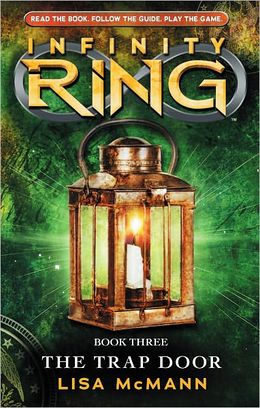 It’s been a few months since the last time I had a book from The Infinity Ring series to plow through and share my thoughts about, so if you need a refresher as to what has been going on in the two books previous you can refer to my comments about book one and book two respectively if you need.
The release of The Infinity Ring: The Trap Door, the third book in the series took me a little by surprise to be honest. I knew it was probably coming out soon, but didn’t know how soon until it randomly showed up on Amazon as a recommended read that had just been released. A pleasant surprise to say the least as I quite enjoy these books even though the target audience is for kids less than half my actual age…
After meeting Christopher Columbus and then taking on a horde of vikings, Dak, Sera, and Riq get to come home to the United States in the year 1850 and see what they can do about the fact that the SQ has taken over the Underground Railroad. I’ll honestly say that I was quite impressed that whomever is planning out the historical events that are being used as plot devices for these books decided to go with the Underground Railroad theme. It’s something we all learn about in school, but then we don’t get a lot of exposure to later in life. I’m guessing that given the target audience is children ages 8-12 that this historical event was chosen on purpose because its one that you learn about when you are that age. Excellent foresight by the editors and authors in my opinion.
While the first two books were mainly about Dak and Sera, this book is almost exclusively about Riq. His ancestors were involved with the Underground Railroad and so the things the three kids are doing are going to have a direct impact on him specifically, possibly even erase his existence. When Riq figures all of this out he has a very serious and impressive moment of growth about who he is, what he stands for, and what he’s willing to give up for the ultimate safety of mankind. I liked that as a reader I finally had the chance to be inside of Riq’s head for a little bit instead of hearing once more about how Dak’s impetuousness dropped the group into a heap of uncalled for trouble.
There is also some pretty important foreshadowing about where things might be going several books down the line in a small scene with Sera that I’m not going to reveal because it will be fun for you to find it on your own. Oh, and Dak finally calms down and seems to understand he can’t just do whatever he wants. Finally.
Next up in the series is The Infinity Ring: Curse of the Ancients, due to be released on June 4, 2013. So, it will be a little while before I get to revisit these books, but if previous evidence can be trusted, it will be worth the wait.
Grade: B
Length: 192 pages
Amazon | Barnes & Noble | Goodreads | Audible
Ready Player One by Ernest Cline
 (Cover picture courtesy of Graeme’s Fantasy Book Review.)
In the year 2044, reality is an ugly place. The only time teenager Wade Watts really feels alive is when he’s jacked into the virtual utopia known as the OASIS. Wade’s devoted his life to studying the puzzles hidden within this world’s digital confines—puzzles that are based on their creator’s obsession with the pop culture of decades past and that promise massive power and fortune to whoever can unlock them.
But when Wade stumbles upon the first clue, he finds himself beset by players willing to kill to take this ultimate prize. The race is on, and if Wade’s going to survive, he’ll have to win—and confront the real world he’s always been so desperate to escape.
I’ll put it bluntly: I really, really enjoyed Ready Player One. Yes, it seems to have the plot of almost every movie where the key to solving a puzzle and winning a huge prize is being nerdy, but that’s the point of Ernest Cline’s debut novel. It’s supposed to be dorky and slightly cliché but is so well written and actually does have quite a few plot twists that you’ll love it anyway.
If you love 80’s pop culture (or even late 90’s), you’ll love Ready Player One. You’ll love it if you like sci-fi, video games, old movies or music. Basically, it’s a hard book not to like. Wade is an awesome character, especially near the end when he matures up a bit and you’d be hard-pressed not to like any of the other important characters like Art3mis, Aech, Shoto or Daito.
Even if you don’t like any of them, the world-building Ernest Cline did is incredible. OASIS is absolutely amazing and a lot of the elements that he put into it (the threat of being charged a user fee, advertisements, using it as an escape) will speak to pretty much all internet users today. Even if you’re not big into the technology scene, if you’ve been paying attention to pop culture at any point in time these past three decades or so, you’ll get at least some of the references. Hey guys, remember Atari?
I give this book 4.5/5 stars.
The Last Days by Scott Westerfeld
 (Cover picture courtesy of Goodreads.)
Strange things are happening: old friends disappearing, angels (or devils) clambering on the fire escapes of New York City. But for Pearl, Moz, and Zahler, all that matters is the band. As the city reels under a mysterious epidemic, the three combine their talents with a vampire lead singer and a drummer whose fractured mind can glimpse the coming darkness. Will their music stave off the end? Or summon it? Set against the gritty apocalypse that began in Peeps, The Last Days is about five teenagers who find themselves creating the soundtrack for the end of the world.
(Summary courtesy of Goodreads.)
Meh. I don’t know what I was really expecting, but I guess I hoped that The Last Days would follow the end of the world more closely. With all the suspense built up at the end of Peeps, I wanted to learn more about the coming worm apocalypse by seeing it through the eyes of someone in the Night Watch on the front lines. However, the group of people we follow in The Last Days knows nothing of peeps or the apocalypse happening around them until the very end, so it was kind of disappointing. This is more my fault than Scott Westerfeld’s because of my preconceived notions, but I definitely would have liked to hear more of how humanity fought the worms rather than just reading a past tense version of it in an epilogue.
Despite the fact it wasn’t what I expected, The Last Days wasn’t a bad book. It took a more serious tone than the first book, but it suited the gritty background very well. The characters were interesting and not exactly what you would expect in a YA novel, so there’s that. Alana Ray was my personal favourite, but I can see where many people would identify with Pearl or Moz. I would have liked the chapters to be a bit longer because at times it felt like head-hopping as each chapter had a different point of view than the previous one. However, that’s more of a personal preference because I like continuity.
In The Last Days I just didn’t feel the same energy or enthusiasm as there was in Peeps. There were some really slow parts where the book dragged on, but other parts were way too fast. My disappointment is partly my own fault for starting to read it with lots of expectations, but I can’t help but feel it didn’t live up to its full potential.
I give this book 3.5/5 stars.