
Category: Speculative Fiction
Matched by Ally Condie
 (Cover picture courtesy of Writing from the Tub.)
Cassia has always trusted the Society to make the right choices for her: what to read, what to watch, what to believe. So when Xander’s face appears on-screen at her Matching ceremony, Cassia knows he is her ideal mate . . . until she sees Ky Markham’s face flash for an instant before the screen fades to black. The Society tells her it’s a glitch, a rare malfunction, and that she should focus on the happy life she’s destined to lead with Xander. But Cassia can’t stop thinking about Ky, and as they slowly fall in love, Cassia begins to doubt the Society’s infallibility and is faced with an impossible choice: between Xander and Ky, between the only life she’s known and a path that no one else has dared to follow.
(Summary courtesy of Amazon.)
Matched by Ally Condie has garnered quite a bit of attention and hype, but once again we must ask ourselves: Does it deserve it?
Well, in a word, no.
Yet because it doesn’t live up to all of the hype doesn’t mean it is a bad novel. In fact, it’s quite a good novel. But is it absolutely amazing and the best thing since man learned how to make fire? Of course not. If I had to classify Matched, I’d put it under the ‘average’ category. It’s an average YA novel, nothing more.
At the risk of sounding like every other book reviewer that’s read this book (and even a few that haven’t), I would describe it as ‘Orwellian’, simply because there is no other word for it. The level of control the Officials have over every aspect of people’s lives is frightening and teens will be able to see the allusions to our own world. For example, every meal is tailored to the individual so they receive the proper amount of nutrition for their age, occupation, metabolism and body type. This could be seen as an allusion to how obsessed we are today with the fitness culture—all Ally Condie did was take things up a notch. People who are so politically inclined could point out that if the government continues to ‘intrude upon our lives’, the society in Matched is a natural progression.
Like in pretty much all YA novels, there is a love triangle. This one, however, is a bit different because in the beginning, Cassia is quite willing to accept Xander as her Match. She didn’t start out as a rebel, but the poem her grandfather gave her and her growing love for Ky change her. One of the best parts of Matched is the character development—the love triangle isn’t forced at all.
So there are quite a few good things about Matched, but I wouldn’t say there was really anything exceptional. It was good, but not memorable because even though I have an excellent memory for books and it’s only been six days since I’ve read this book, I wasn’t able to remember the name of the main character without looking it up. I can recall every detail of Scroll of Saqqara, name every character in Feed and can rant about everything I hated about Inheritance for hours, but I wasn’t able to remember Cassia. Which, of course, brings me back to my original point: Matched is good, but it’s not great or memorable.
I give this book 3.5/5 stars.
Tomorrow Land by Mari Mancusi
 (Cover picture courtesy of Goodreads.)
Can true love survive the end of the world?
Imagine finding your first love, only to be ripped apart by the apocalypse. Peyton Anderson will never forget the day she was forced to make a choice–between her family–and Chris Parker, the boy she’d given her heart. Now, four years later, as she steps from the fallout shelter and into a dead and broken world, he’s the only thing on her mind.
All Chris “Chase” Parker wanted was to take Peyton away and keep her safe from harm. But he waited for hours in the rain on judgment day and she never showed–breaking his heart without ever telling him why.
Now the two of them have been thrown together once again, reluctant chaperones to a group of orphan children in a post-apocalyptic world where the dead still walk…and feed. As they begin their pilgramage [sic] to the last human outpost on Earth, can they find a way to let go of old hurts and find the love they lost–all while attempting to save what’s left of the human race?
(Book blurb courtesy of Mari Mancusi’s website.)
[Full disclosure: I received a free ebook copy from NetGalley in exchange for an honest review.]
For all of you zombie lovers out there, be warned: this is more of a romance novel with zombies than a zombie novel with romance. Like Feed, it focuses on how people are affected after a zombie apocalypse. It doesn’t really get into the nitty-gritty of how the virus works (much to my dismay), but it does give a nice explanation, unlike in The Forest of Hands and Teeth, which doesn’t give any explanation at all.
The story switches between Peyton’s and Chris’ points of view to keep up the suspense, and I think this works well. Both characters are well-developed and you can really feel the raw pain they experience when they see each other again. Chris’ addiction to painkillers heightens the suspense even more and I love how he is ready to quit because of Peyton. The only thing that didn’t sit well with me was how long it took from exposure to death and re-animation in this book. In Tomorrow Land, it can take up to 2 weeks before you actually turn! Since most common viruses take 4-7 days to incubate, that seems a little ridiculous to me.
The plot moves along at a fairly fast rate, in spite of all of the backstory scenes about how the outbreak began and Peyton and Chris’ respective choices. Personally, the ending seemed much too rushed, especially because of the big twist the plot took. Otherwise, Mari Mancusi has penned a nice romance with zombies thrown in for fun. If you love naturally developing romances, you will love this book.
I give this book 4/5 stars.
Amazon (Kindle)* Barnes and Noble (Nook)*
*If you want the paperback edition, it is called Razor Girl and is only available through used book sellers.
Feed by Mira Grant
 (Cover picture courtesy of Tansyrr.)
The year was 2014. We had cured cancer. We had beaten the common cold. But in doing so we had created something new, something terrible that no one could stop. The infection spread, virus blocks taking over bodies and minds with one, unstoppable command: FEED.
Now, twenty years after the Rising, Georgia and Shaun Mason are on the trail of the biggest story of their lives—the dark conspiracy behind the infected. The truth will out, even if it kills them.
“Our story opens where countless stories have ended in the last twenty-six years: with an idiot—in this case, my brother Shaun—deciding it would be a good idea to go out and poke a zombie with a stick to see what happens.”
When a book starts out like this, you know it’s going to be good. As many of my readers know, I have a serious fear of zombies that was triggered when I watched Dawn of the Dead at the age of eight. I bought this book to cure myself of this irrational fear and I truly think Mira Grant’s biting wit (pardon the pun) and excellent characters have cured me. Zombies don’t scare me any longer, so now I can get on with my review.
Feed is told mostly from the point of view of Georgia Mason—George for short—and she is an excellent narrator. She is a three dimensional character that is brave, resourceful and protective of her reckless brother Shaun. And unlike many female characters, she doesn’t fall in love through the course of the story. In fact, there is no romance whatsoever for the main characters, which is definitely a refreshing change.
I would call Feed more of a political thriller with zombies than a zombie book with politics. The political atmosphere in a post-Rising world is very different from what it is now, but it makes a lot of sense in the context. There is much less active participation because of the fear of the Kellis-Amberlee virus infecting you. And of course the reclamation of zombie-infested lands like Alaska and parts of California is the hot-button issue of the day. As George and Shaun uncover a conspiracy while on the campaign trail with Senator Ryman, the plot moves along even more quickly than before toward its tragic ending.
I give this book 5/5 stars.
Pretties by Scott Westerfeld
 (Cover picture courtesy of Wikipedia.)
Tally has finally become pretty. Now her looks are beyond perfect, her clothes are awesome, her boyfriend is totally hot and she’s completely popular. It’s everything she’s ever wanted.
But beneath all the fun—the nonstop parties, the high-tech luxury, the total freedom—is a nagging sense that something’s wrong. Something important. Then a message from Tally’s ugly past arrives. Reading it, Tally remembers what’s wrong with pretty life, and the fun stops cold.
Now she has to choose between fighting to forget what she knows and fighting for her life—because the au authorities don’t intend to let anyone with this information survive.
When I first read Pretties, I was infuriated by all the slang the pretties used. But on a second read through, I realized that it demonstrates Tally’s drastic transformation from who she was in Uglies. The slang also shows how vapid pretties are and how much the surgery really affects their minds, instead of only their bodies.
Pretties follows Tally and her new boyfriend Zane as they try to defeat the brain lesions that impair their judgment, coordination and memory. They try all manner of things to stay ‘bubbly’ and it seems like the two pills from Tally’s fugitive friends in the New Smoke are working. But tensions rise as Tally pushes away her old friend Shay and the authorities start to catch on to what Zane and Tally are up to. Tally makes some hard decisions and old friends turn into enemies in the second book of the Uglies trilogy.
I read this book when I was twelve and it really struck a chord with me. Everyone at school was telling me I was ugly (either directly or indirectly) and Pretties gave me a bit more confidence in myself, if only for a short while. It taught me that being pretty isn’t everything and that the pursuit of perfection often leads to ruin. That’s why I recommend this book for tweens and younger teens, especially those with self-esteem problems. Scott Westerfeld deserves to be among the YA greats and the unflinching way he confronts self-esteem issues is inspiring.
I give this book 4.5/5 stars.
Mockingjay by Suzanne Collins
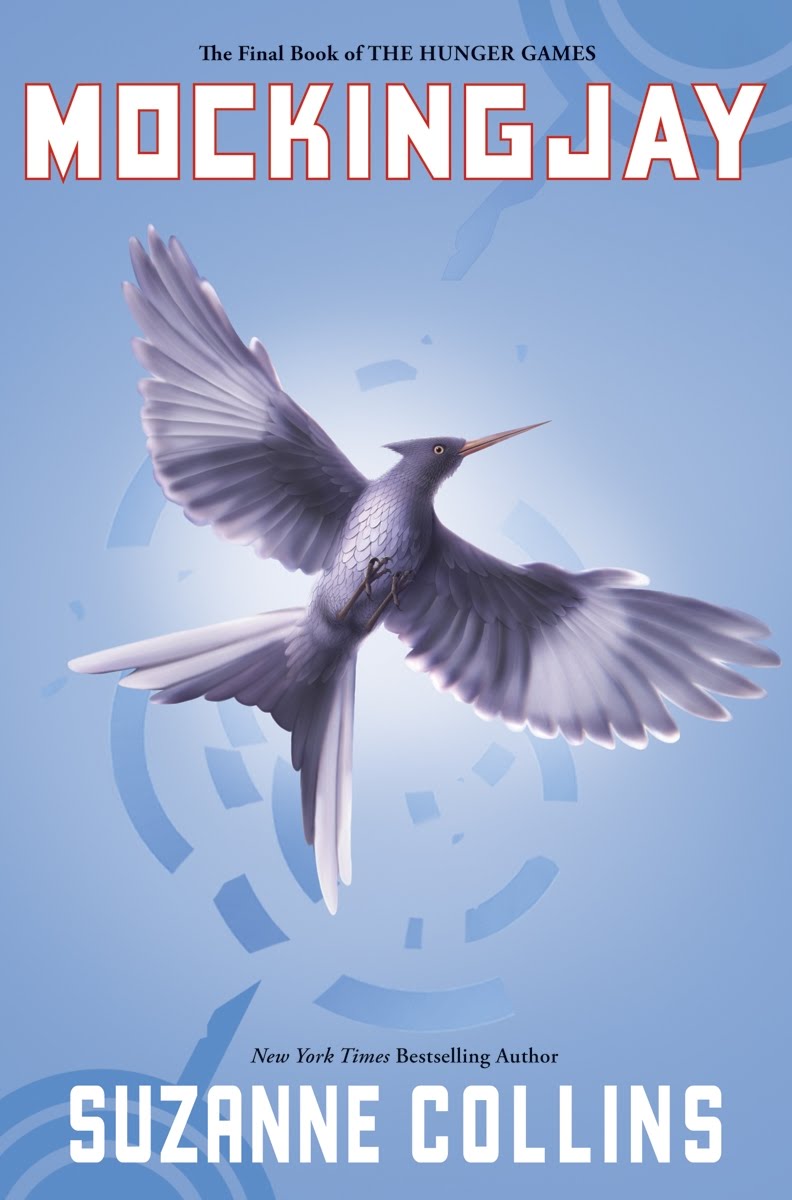 (Cover picture courtesy of The Book Smugglers.)
Katniss Everdeen, girl on fire, has survived, even through her home has been destroyed. Gale has escaped. Katniss’s family is safe. Peeta has been captured by the Capitol. District 13 really does exist. There are rebels. There are new leaders. A revolution is unfolding.
It is by design that Katniss was rescued from the arena in the cruel and haunting Quarter Quell, and it is by design that she has long been part of the revolution without knowing it. District 13 has come out of the shadows and is plotting to overthrow the Capitol. Everyone, it seems, has had a hand in the carefully laid plans—except Katniss.
The success of the rebellion hinges on Katniss’s willingness to be a pawn, to accept responsibility for countless lives, and to change the course of the future of Panem. To do this, she must put aside her feelings of anger and distrust. She must become the rebels’ Mockingjay—no matter what the personal cost.
I loved the Hunger Games trilogy up until this last book. I wish it could have ended better, but it didn’t.
In Mockingjay, Katniss has transitioned from a strong, independent-minded protagonist to an annoying, whiny narrator. All she really does throughout the novel is watch District 13 fight the Capitol and moan about how they’re using her as their symbol. She dodges training sessions, which explains why the rebels are annoyed at her all of the time. Katniss also angsts about how the rebels are using her, which I find annoying. If you’re trying to overthrow an evil empire, which is more important: your independence or winning the war? And if it takes being used to win, isn’t that worth it?
This might just be me, but I found the ending rather disappointing. As if to demonstrate the total senselessness of war, Suzanne Collins kills of 90% of the characters we meet. I can understand some deaths (after all, it is a war), but I don’t like how she killed off almost everyone, then wrote a ‘happy’ epilogue to stop her readers from tearing her to shreds. To me, it’s reminiscent of how JK Rowling ended the Harry Potter series, then wrote a poorly-written hurried epilogue to placate her readers.
In some ways, I wish The Hunger Games had been a stand-alone novel. What do you think? Were you satisfied with the ending? Or did it feel forced? Please tell me in the comments below.
I give this book 2/5 stars.