The Week Ahead (#6)

Last week was pretty chaotic but I think things have settled down enough that I can have a somewhat consistent posting schedule this week.  My life is still a mess but I guess I’ve just become accustomed to this new level of stress.  Life goes on, as the saying goes.

Monday

  • Guest Post: All History is Fiction.  At the beginning of the month an author of historical fiction contacted me offering to guest post so I’m very excited to finally be publishing his very thoughtful article.

Tuesday

Evermore by Alyson Noel

  • The missing review of Evermore by Alyson Noel.  I had intended to publish it on Thursday of last week but life got in the way so I’ll publish it this Tuesday.


Wednesday

After the End by Amy Plum

  • A review of After the End by Amy Plum.  I was lucky enough to receive a paperback ARC from the publisher of this novel so I can’t wait to finally be able to publish my review of the book.


Thursday

Sworn to Defiance by Terah Edun

  • The Best and Worst of April 2014.  It’s May 1 on Thursday so of course I’ll be adding another article to my Best and Worst of…series
  • A review of Sworn to Defiance by Terah Edun.  I’m more than a little scared about the last book in the series but at the same time I’m excited to see how things end up.


Friday

  • Cover Reveal: Blades of Illusion by Terah Edun.

Saturday

  • Discussion: Separating the Creator From Their Work.  Is it possible to separate an author or artist whose views you disagree with from their work that you love?

Discussion: Beta Reading

Beta reading is when an author gives someone their manuscript to look over.  Most beta readers don’t get paid and they only critique things like characters, pacing, plot holes, etc.  Some beta readers are authors doing it for other authors so they can return the favour.  Sometimes fans of authors volunteer to be beta readers so they get a first-hand look at the story before everyone else and have a say in helping it along.

Personally, beta reading for free has never really appealed to me.  I’m not so interested in any author that I would volunteer to read their rough manuscript for free.  I certainly do read ARCs but those are at least somewhat polished before they get into my hands and I can actually do a review for them so my time is worthwhile.  Unless JK Rowling herself asked me to beta read, I don’t see myself doing it for free in the future.  If I were paid to do it, that would be another story.

What I want to know now is: would you ever beta read?  Why or why not? If you have been a beta reader, why did you do it?  Who was it for?  Did you like it?

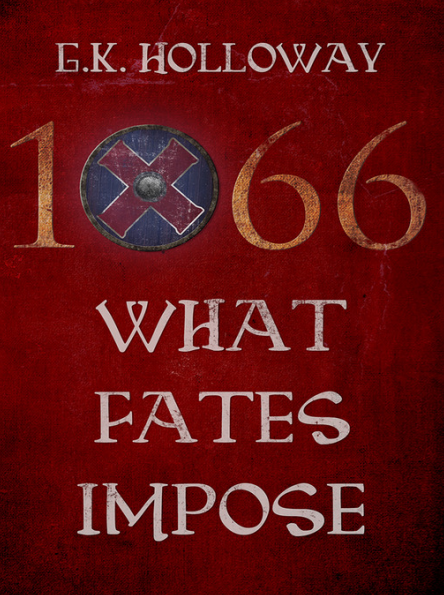
Book Blast: 1066: What Fates Impose by G. K. Holloway

Please join G.K. Holloway on he tours the blogosphere for 1066: What Fates Impose, from April 14 – May 2.

1066 What Fates Impose1066 What Fates ImposePublication Date: March 4, 2013
Matador Publishing

King William then utters the following words to the room: ‘I appoint no one as my heir to the Crown of England, but leave it to the disposal of the Eternal Creator, whose I am and who orders all things. For I did not attain that high honour by hereditary right, but wrested it from the perjured King Harold in a desperate bloody battle.’

England is in crisis. King Edward has no heir and promises never to produce one. There are no obvious successors available to replace him, but quite a few claimants are eager to take the crown. While power struggles break out between the various factions at court, enemies abroad plot to make England their own. There are raids across the borders with Wales and Scotland.

Harold Godwinson, Earl of Wessex, is seen by many as the one man who can bring stability to the kingdom. He has powerful friends and two women who love him, but he has enemies will stop at nothing to gain power.  As1066 begins, England heads for an uncertain future. It seems even the heavens are against Harold.

Intelligent and courageous, can Harold forge his own destiny – or does he have to bow to what fates impose?

Continue reading

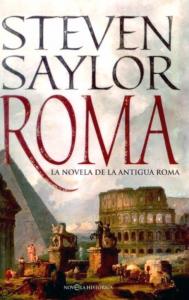
Roma by Steven Saylor

Roma by Steven Saylor(Cover picture courtesy of Liberia Estudio en Escarlata.)

Spanning a thousand years, and following the shifting fortunes of two families though the ages, this is the epic saga of Rome, the city and its people.


Weaving history, legend, and new archaeological discoveries into a spellbinding narrative, critically acclaimed novelist Steven Saylor gives new life to the drama of the city’s first thousand years — from the founding of the city by the ill-fated twins Romulus and Remus, through Rome’s astonishing ascent to become the capitol of the most powerful empire in history. Roma recounts the tragedy of the hero-traitor Coriolanus, the capture of the city by the Gauls, the invasion of Hannibal, the bitter political struggles of the patricians and plebeians, and the ultimate death of Rome’s republic with the triumph, and assassination, of Julius Caesar.


Witnessing this history, and sometimes playing key roles, are the descendents of two of Rome’s first families, the Potitius and Pinarius clans:  One is the confidant of Romulus. One is born a slave and tempts a Vestal virgin to break her vows. One becomes a mass murderer. And one becomes the heir of Julius Caesar. Linking the generations is a mysterious talisman as ancient as the city itself.


Epic in every sense of the word, Roma is a panoramic historical saga and Saylor’s finest achievement to date.

When I first started Roma I’ll admit I did have my doubts because of Steven Saylor’s telling rather than showing style of writing.  However, I got into the swing of things and actually began enjoying his pared-down style that reads almost like a more intimate nonfiction work about the lives of two ancient Roman clans.

One of the most obvious strengths of Steven Saylor’s writing is the historical accuracy of the novel.  He does change some events around and speculate about some things but where there was information available he stuck to the facts.  I like how he doesn’t play the origins of ancient Rome straight (i.e. with gods and such) but rather offers up some explanations for how the heck such fantastical stories about Rome’s founding came about.  It makes sense and it’s quite possible that some of these things actually happened in a similar way and that’s why I really loved how Steven Saylor stayed true to the history.

His characters are amazing.  Every single one has a different perspective and a very unique voice.  They all live in turbulent times in Rome’s history so of course their lives are fascinating but it’s how they deal with the changing times that really stands out.  Some of the earlier Pinarii are quite snobby about their patrician status; later when the family is poor that’s not really the case.  Of course some of the ideas presented by characters will seem utterly absurd to modern readers but they really capture the prevailing attitudes of the time.

I can’t in all honesty call the plot fast-paced but it was very interesting.  I mean, how could Roman history not be interesting?  We get to see the events surrounding the first sack of Rome, the rise of Julius Caesar, the Second Punic War, etc.  All of the major events during the Republic period of ancient Rome are here in the novel or at least are alluded to because the characters are still dealing with the aftereffects of said events.  It’s a fascinating look at Roman history and although there was more telling than showing I still thoroughly enjoyed Roma.

I give this book 4/5 stars.

Amazon     Barnes and Noble     Goodreads