The Case is Solved

As you may have noticed, I didn’t post a review yesterday.  But never fear, I did actually review The Amaranth Enchantment by Julie Berry.  Instead of posting it here, you may find it over at We Heart Reading, where I am an author as well.  I’ll still post a link to it on the ‘My Reviews’ page, but the link will take you outside of my site.

The Hunger Games and Ancient Rome

As I mentioned before in my review of The Hunger Games by Suzanne Collins, The Hunger Games is really one huge allusion to the Roman Empire.  For those of you who don’t know what an allusion is, Dictionary.com defines allusion as “a passing or casual reference; an incidental mention of something, either directly or by implication.”  There are a lot of allusions in The Hunger Games, but I have always been fascinated by Roman history, so now I will attempt to go into more detail about all of the allusions to the Roman Empire I found in the trilogy.

1.  The Games themselves.

The Roman Colosseum as we know it was started by the emperor Vespasian and finished by his son Titus Flavius in 80 A.D.  It soon became popular for its spectacular gladiatorial games, animal fights and even its mock sea battles when they would actually flood the arena and bring in ships.  All these things were meant for the public’s viewing pleasure and they served to raise the popularity of the emperors.  The Games that the Capitol holds every year serve as entertainment as well, but also publicly demonstrate its power over the districts.  The Hunger Games are every bit as brutal and inventive as the gladiatorial games. Continue reading

A Change of Plan

Tomorrow, I will be posting an essay about a certain popular YA book and its startling similarities to the Roman Empire.  Instead of posting my review of The Amaranth Enchantment by Julie Berry here, I will be posting it over at We Heart Reading as my first ever guest post*.  I’ll be posting a link to that here, so don’t worry.

*Technically, it’s my second guest post, but my first actual guest post isn’t scheduled to appear until March 30.

The Reckoning by Kelley Armstrong

(Cover picture courtesy of Atom Books.)

My name is Chloe Saunders.  I’m fifteen, and I would love to be normal.

But normal is one thing I’m not.

To start with, I’m having these feelings for a certain antisocial werewolf and his sweet-tempered brother—who just happens to be a sorcerer—but, between you and me, I’m leaning toward the werewolf.

Not normal.

My friends and I are also on the run from an evil corporation that wants to get rid of us—permanently.

Definitely not normal.

And finally, I’m a genetically altered necromancer who can raise the dead, rotting corpses and all, without even trying.

As far away from normal as it gets.

Just like The Hunger Games, I wish The Summoning had been a stand-alone novel.  It wasn’t, so I was stuck reading The Reckoning, a terrible end to what had potential to be an amazing series.  Alas, Kelley Armstrong did not take the series to the next level.

My main problem is the cliché factor.  Necromancers are definitely new in the YA scene as they don’t have that vampire appeal, but that’s not what I have a problem with.  But the rest of the book?  Well, it’s pretty cliché.  Like a lot of YA books, it involves a huge love triangle, but for whatever reason it just doesn’t work.  Some books can pull off love triangles very well, but this is not one of those books.  It really ends up making Chloe into a Mary Sue, which is kind of is anyway, even without the love triangle.  Not only are the character clichéd, but the whole evil-corporation-genetically-engineers-people-then-wants-to-kill-them premise is old and utterly predictable.

The plot of The Reckoning just drags on and on, as if Kelley Armstrong suddenly had the urge to describe all of the corpses Chloe raises in mind-numbing detail.  I have a pretty strong stomach when it comes to gore (or else I would never, ever look up things like this for fun), but I did notice my appetite disappeared after reading this book.  This is a YA book, but it is not for the sensitive.

I give this book 2/5 stars.

Amazon     Barnes and Noble

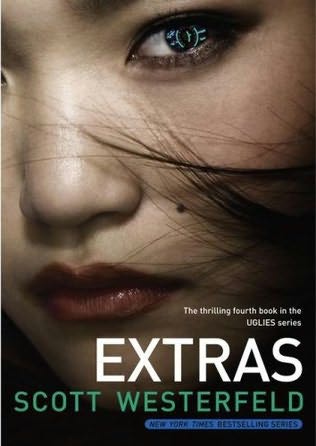
Extras by Scott Westerfeld

(Cover picture courtesy of Fantastic Fiction.)

A few years after rebel Tally Youngblood takes down the Specials regime, a cultural renaissance sweeps the world.  “Tech-heads” flaunt their latest gadgets, “kickers” spread gossip and trends, and “surge monkeys” are hooked on extreme plastic surgery.  Popularity rules, and everyone craves fame.

Fifteen-year-old Aya Fuse is no exception.  But Aya’s face rank is so low, she’s a total nobody.  An extra.  Her only chance at stardom is to kick a wild and unexpected story.

Then she stumbles upon a big secret.  Aya knows she is on the cusp of celebrity.  But the information she is about to disclose will change both her fate…and that of a brave new world.

If you’ve read the first three books in the Uglies trilogy (which was turned into a series with the release of this book), you will get so much more enjoyment out of Extras.  You’ll be able to see just how different Tally’s world has become and yet how much it is like our own world.  In Aya’s world, popularity rules.  The more popular you are, the more credits you get and the better your life is.  But anyone who is not popular—which is most of the population—is an extra, a nobody.  Does this remind anyone of high school?

What really stands out in Extras (for me at least) is the explosion of new technologies since Specials.  Since practically no one over 16 is a bubblehead anymore, intelligence has been allowed to flourish and Scott Westerfeld describes the new advances in spectacular detail.  With all of that new technology and freedom, “surges”—or surgeries—have also become popular, especially the extreme kind.  It is a credit to Scott Westerfeld’s world-building abilities that he includes all kinds of people who change their bodies to create their idea of ‘true beauty.’  I find it fascinating what people choose to look like in Aya’s world since they are allowed to change themselves into whoever they want.

As usual, Scott Westerfled’s characterization is spot-on.  Many readers will sympathize with Aya because she is the voice of teenage insecurity.  Surrounded by beautiful people and being nothing more than an unimportant, faceless extra has really taken its toll on her.  As a result, many teenagers will sympathize with her insecurities and will cheer her on as the plot speeds along.

I give this book 4/5 stars.

Amazon     Barnes and Noble