Specials by Scott Westerfeld

(Cover picture courtesy of Regular Rumination.)

Tally thought they were a rumor, but now she’s one of them.  A Special.  A super-amped fighting machine, engineered to keep the uglies down and the pretties stupid.

But maybe being perfectly programmed with strength and focus isn’t better than anything she’s ever known.  Tally still has memories of something else.

But it’s easy for her to tune them out—until she’s offered a chance to stamp out the rebels of the New Smoke permanently.  It all comes down to one last choice: listen to that tiny, faint heart-beat, or carry out the mission she’s programmed to complete.  Either way, Tally’s world will never be the same.

For all of Scott Westerfeld’s amazing writing talent, I did not enjoy Specials nearly as much as I enjoyed Uglies or Pretties.  It was not because it lacked plot—it actually had an excellent plot—but I found that I really could not relate to Tally anymore.  I related to her as an unsure ugly and an airheaded pretty, but I could not relate to her as a cruel special.  True, her mind has been altered along with her body to become more predatory, but practically nothing of the old Tally remains.  Despite all of her faults, I understood and empathized with the old Tally.

Aside from Tally’s completely 180, Specials is not a bad book.  The plot zips right along at a consistently quick rate and the stakes are higher than ever before.  Tally has to make incredibly difficult, life-changing decisions as she tries to fight the new lesions that control her mind.  Friends turn into enemies and the walls of deceit that were built up through the centuries begin to crumble in the last book in the Uglies trilogy.

If you have read the other two books, then you will likely enjoy Specials.  It’s exciting and Tally does great things, but there is also a lot of tragedy, especially near the end.  I actually liked the ending and it leaves a lot of room for readers’ imaginations to take flight without completely leaving them hanging.

I give this book 3.5/5 stars.

Amazon     Barnes and Noble

City of Glass by Cassandra Clare

(Cover picture courtesy of Once Upon a Reader’s Blog.)

To save her mother’s life, Clary must travel to the City of Glass, the ancestral home of the Shadowhunters—never mind that entering the city without permission is against the Law, and breaking the Law could mean death.  To make things worse, she learns that Jace does not want her there, and Simon has been thrown in prison by the Shadowhunters, who are deeply suspicious of a vampire who can withstand sunlight.

As Clary uncovers more about her family’s past, she finds an ally in the mysterious Shadowhunter Sebastian.  With Valentine mustering the full force of his power to destroy all Shadowhunters forever, their only chance to defeat him is to fight alongside their eternal enemies.  But can Downworlders and Shadowhunters put aside their hatred to work together?  While Jace realizes exactly how much he’s willing to risk for Clary, can she harness her newfound powers to help save the Glass City—whatever the cost?

Love is a mortal sin and the secrets of the past prove deadly as Clary and Jace face down Valentine in the New York Times bestselling trilogy The Mortal Instruments.

In City of Glass, I have found something incredibly rare: a good ending to a series.  I’m completely serious here; there are very few ends to series that leave me feeling satisfied.   But City of Glass is definitely one of these books.

It’s exciting, with consistent pacing and much more character development than in the first two novels in the trilogy.  Cassandra Clare’s writing has noticeably improved and she is in her element as she ratchets up the tension near the end while resolving little subplots along the way.  What separates her from other YA authors is that she can throw truly unexpected twists at readers, yet have them make sense in the context of the story.

Unlike in the last two books, Clary is given much more depth.  She finally takes control of her life rather than just helplessly pining after Jace throughout the novel.  As she harnesses her special drawing talent with Runes, she also becomes powerful and independent.  When Jace pushes her away, she finally has enough of loving someone she cannot have and begins to take an interest in Sebastian, a mysterious and handsome young Shadowhunter around her age.  Yet not everything is as it seems, which makes this a great book.

I give this book 4/5 stars.

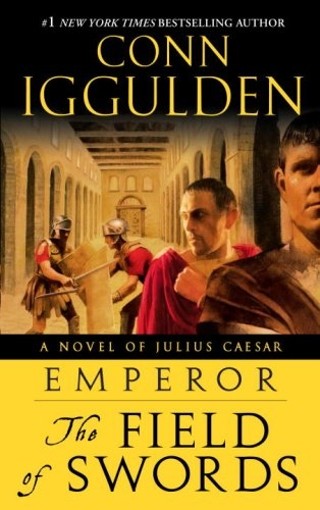
Emperor: The Field of Swords by Conn Iggulden

(Cover picture courtesy of GetGlue.)

For Julius Caesar, the time has come to enter the political battleground that has become Rome.  Having proved his valor in the slaves’ revolt, Caesar is strengthened by the love of a beautiful older woman—and by the sword of his loyal friend Marcus Brutus.  But it is Caesar’s next move that will change history.  With an army made in his own image, Caesar begins a daring charge through Gaul, across the English Channel, and to the wilds of tribal Britain.

Here, in a series of cataclysmic clashes, the legend of Julius Caesar will be forged.  And while Caesar and Brutus battle the armies of the wilderness, their political adversaries in Rome grow ever more powerful.  For when the fighting is over, the greatest danger to Julius Caesar will await him on the Tiber—with a man who wants Rome himself.

The Field of Swords is truly riveting historical fiction of the first order and Conn Iggulden managed to write it without changing history around as much.  Surprisingly, the third book in his Emperor series is my favourite out of all four because it is by far the most exciting in terms of plot and character development.  It covers the most famous part of Caesar’s life: the Gallic Wars.

War is one of my favourite parts of historical fiction because of all the details of ancient warfare fascinate me.  History textbooks do not even begin to cover how physically, mentally and emotionally draining it was on the men and those who had to lead them.  Warfare was not a glorious event and Iggulden perfectly hammers this point home.

I absolutely love the character development in this book.  Caesar becomes more independent as all of his old tutors and friends die off, leaving him with Brutus as his only friend.  How could his only friend orchestrate Caesar’s death?  Well, there is a very telling scene near the end of the book when Caesar suffers from an epileptic fit and is unable to lead his men in battle.  Brutus dons Caesar’s armour and leads his men into battle.

“You led them?”  Julius said.  Though his voice was strengthening, he still seemed confused.

“No Julius.  They followed you.”

Thus the seeds of jealousy were planted in Brutus’ heart.

I give this book 4.5/5 stars.

Amazon     Barnes and Noble

The Hitchhiker’s Guide to the Galaxy by Douglas Adams

(Cover picture courtesy of That’s 2 For The Books.)

On 12 October 1979 the most remarkable book ever to come out of the great publishing corporations of Ursa Minor (and Earth) was made available to humanity – The Hitchhiker’s Guide to the Galaxy.

It’s an ordinary Thursday lunchtime for Arthur Dent until his house gets demolished. The Earth follows shortly afterwards, to make way for a new hyperspace bypass.  And his best friend just announced that he’s an alien. At this moment, they’re hurtling through space with nothing but their towels and an innocuous-looking book inscribed with the big, friendly words: DON’T PANIC.

The weekend has only just begun…

At first, I hated this book.  But then about halfway through, I finally caught on to Douglas Adams’ fantastic sense of humour.  Yes, I’m ashamed it took me that long to catch on, but now I can honestly say The Hitchhiker’s Guide to the Galaxy is unlike any other book I have read before.  It’s ironic, witty and it subtly pokes fun at a lot of science fiction clichés.

Aside from being laugh-out-loud funny in spots, the plot moves along quite nicely.  The book is only a little over 100 pages, yet more happens in those 100 pages than in the over 700 pages of Brisingr.  Douglas Adams’ easy to read, pared down style is a truly refreshing break from the exhausting descriptions of most sci-fi/fantasy novels.  His dialogue is also what sets him apart; I read it aloud and it actually sounded how real people speak.

Of course my favourite part of the novel was the unforgettable characters.  Ford Perfect, Zaphod Beeblebrox, Slartibartifast and many others are very memorable and will never truly leave you.  They’re quirky, unique and, at times, utterly hilarious, which is what makes them stand out so much.  The characters are just one of the many reasons to read this great novel.

I give this book 5/5 stars.

Amazon     Barnes and Noble

The Lightning Thief by Rick Riordan

(Cover picture courtesy of  Rick Riordan’s website.)

Percy Jackson is about to be kicked out of boarding school…again.  And that’s the least of his troubles.  Lately, mythological monsters and the gods of Mount Olympus seem to be walking straight out of the pages of Percy’s Greek mythology textbook and into his life.  And worse, he’s angered a few of them.  Zeus’s master lightning bolt has been stolen, and Percy is the prime suspect.

Now Percy and his friends have just ten days to find and return Zeus’s stolen property and bring peace to a warring Mount Olympus.  But to succeed on his quest, Percy will have to do more than catch the true thief: he must come to terms with the father who abandoned him; solve the riddle of the Oracle, which warns him of betrayal by a friend; and unravel a treachery more powerful than the gods themselves.

You’ve probably heard this before, but The Lightning Thief has a very Harry Potter-esque feel.  It’s not quite on the same level, but it is a very good book.  What I like most about it is that it can be read by teenage boys, who are extremely under-represented in the YA genre.  Rick Riordan has tapped into this market and I hope more authors will follow his lead and write for boys, who actually do read.

With just the right amount of action and tension, The Lightning Thief is a worthwhile read.  Percy Jackson is a very sympathetic protagonist and I love the fact that the series is told by him in first person, which brings us closer to him.  Despite being half-god, he is not all-powerful and often needs to be rescued by his companions as he journeys across the country to find Zeus’s lightning bolt.  But he is not entirely helpless either, which stops him from becoming an annoyingly incompetent character.

Even if you don’t know much about Greek mythology, you will get a lot out of this book.  Rick Riordan has obviously done his research and I love the personality quirks of the gods we meet along the way, especially Mars.  If there was only one reason to read this book, it would be because of the gods.

I give this book 4.5/5 stars.

Amazon     Barnes and Noble