The Magician by Michael Scott

(Cover picture courtesy of Michael Scott’s website.)

California:

In the hands of Dr. John Dee and the Dark Elders, the book of Abraham the Mage could mean the destruction of the world as we know it.  The most powerful book of all time, it holds the secret of eternal life—a secret more dangerous than any one man should ever possess.  And Dee is two pages away from the knowledge that would bring the Dark Elders into ultimate power.

His only obstacle?  Josh and Sophie Newman—who are eight thousand miles away.

Paris:

After fleeing Ojai, Nicholas, Sophie, Josh, and Scatty emerge in Paris.  The City of Light.  Home to Nicholas Flamel.  Only, this homecoming is anything but sweet.

Niccoló Machiavelli, immortal author and celebrated art collector, lives in Paris and is working for Dee.  He’s in hot pursuit, and time is running out for Nicholas and Perenelle.  Every day they spend without the book, they age one year: their magic becomes weaker and their bodies more frail.  For Flamel, the Prophecy is clearer and clearer.  It’s time for Sophie to learn the second elemental magic.

Fire magic.

And there’s only one man who can teach it to her: Flamel’s old student the Comte de Saint-Germain—alchemist, magician, and rock star.

Josh and Sophie Newman are the world’s only hope.  If they don’t turn on each other first.

The Magician is a great second book in The Secrets of the Immortal Nicholas Flamel series, with its fast-paced plot, new and more terrifying creatures and amazing characterization.  It’s actually one of the rare second books that I like better than the first book.

Michael Scott continues his amazing characterization by introducing new and far more interesting characters like the Comte de Saint-Germain, Joan of Arc and the infamous Niccoló Machiavelli.  Sophie and Josh are given much more depth as Sophie learns new magic and as Josh grows more jealous of his Awakened twin.  We also learn more about Nicholas Flamel, Scatty and Dr. John Dee, who is one of my favourite characters, aside from Machiavelli.

What I love most about The Magician is that Michael Scott does not neglect his villains.  Dee and Machiavelli are very interesting and are given realistic motivations for following the Dark Elders.  They also think they are doing the right thing, which is better than your typical YA villain that thinks they truly are a villain.

By far the best thing about Michael Scott’s writing is that he blends mythology and legends from many cultures together.  We meet Mars from Roman mythology, Nidhgg and the Valkyries from Norse Mythology and even Dagon from John Milton’s Paradise Lost.  I love mythology, but even people with no prior interest in it will love The Magician.

I give this book 4/5 stars.

The Many Diseases Found in Fiction (YA Fiction in Particular)

Disclaimer

This list has been compiled for educational purposes only.  It is not intended to belittle the authors/characters mentioned or any sort of disease.

Dr. No Syndrome: A terrible, debilitating syndrome that afflicts only the villains of a novel.  Its symptoms include maniacal laughter, insanity, the wearing of dark colours and a general lack of realistic motivation.  Dr. No Syndrome is a silent killer and may prove fatal to an author’s credibility and any suspense that has built up before the villain’s appearance.  It is most prominent, but certainly not limited to, the fantasy genre.

Book Two Disease: A common, mild disease that afflicts around 90% of book series.  Its many symptoms include poor writing, no character development, subplots that go nowhere and in its most severe cases, the resurrection of a favourite character from the first book.  Book Two Disease is rarely fatal as a writer’s fans will usually continue reading the series to see what happens in the end.  Unfortunately, it spans across all genres. Continue reading

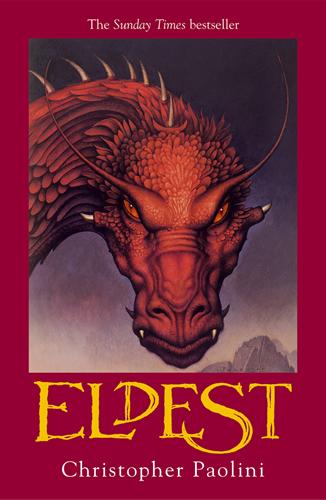
Eldest by Christopher Paolini

(Cover picture courtesy of Gil T.’s Pleasures.)

Darkness falls…

Swords clash…

Evil reigns.

Eragon and his dragon Saphira, have just saved the rebel state from destruction by the mighty forces of King Galbatorix, cruel ruler of the Empire.  Now Eragon must travel to Ellesméra, land of the elves, for further training in magic and swordsmanship, the vital skills of the Dragon Rider.  It is the journey of a lifetime, filled with awe-inspiring new places and people, each day a fresh adventure.  But chaos and betrayal plague him at every turn and Eragon isn’t sure whom he can trust.

Meanwhile, his cousin Roran must fight a new battle back home in Carvahall—one that puts Eragon in even graver danger.

Will the king’s dark hand strangle all resistance?  Eragon may not escape with even his life.

Oh dear, where do I begin with this book?

First, let’s start with the many clichés, shall we?  The farm boy with secret powers/a special destiny is already as old as dirt, but what really annoys me is all of the races in Christopher Paolini’s world.  The elves are fair, powerful and are forest-dwelling agnostics/atheists.  The dwarves are shot, good stonemasons and are mountain-dwelling polytheists.  What bothers me is not the religion (which is a mark of good world-building), but the fact that these elves and dwarves are exactly the same as all of the other elves and dwarves in high fantasy.  They’re all based off elves and dwarves in Norse mythology, which is fine, but I’d like to see a bit more variety.  Why not use races from African or Asian mythologies?

Second, the plot drags on and on, rotating between Eragon and Roran.  This would be okay if either character was sufficiently developed so they could hold my attention for more than a page.  But they aren’t, which makes the changes seem like head-hopping.  The entire plot of Eldest is pretty much Eragon travelling to or spending time with the elves and Roran pulling a Julius Caesar.  Of course, Paolini adds in a quick battle at the end with a ‘plot twist’ most Star Wars fans could see coming a mile away.  Roran and all of Carvahall come in one ship and completely turn the tide of the battle, which almost—but not quite—a Deus ex Machina.

Third, Paolini still uses way too much description.  I love vivid imagery, but my patience (and attention span) has a limit.  If Eldest had been written by someone like Conn Iggulden or Michael Scott, who have just the right amount of description, it would have been pared down to less than 300 pages.

I give this book 1/5 stars.

Amazon     Barnes and Noble

Pretties by Scott Westerfeld

(Cover picture courtesy of Wikipedia.)

Tally has finally become pretty.  Now her looks are beyond perfect, her clothes are awesome, her boyfriend is totally hot and she’s completely popular.  It’s everything she’s ever wanted.

But beneath all the fun—the nonstop parties, the high-tech luxury, the total freedom—is a nagging sense that something’s wrong.  Something important.  Then a message from Tally’s ugly past arrives.  Reading it, Tally remembers what’s wrong with pretty life, and the fun stops cold.

Now she has to choose between fighting to forget what she knows and fighting for her life—because the au authorities don’t intend to let anyone with this information survive.

When I first read Pretties, I was infuriated by all the slang the pretties used.  But on a second read through, I realized that it demonstrates Tally’s drastic transformation from who she was in Uglies.  The slang also shows how vapid pretties are and how much the surgery really affects their minds, instead of only their bodies.

Pretties follows Tally and her new boyfriend Zane as they try to defeat the brain lesions that impair their judgment, coordination and memory.  They try all manner of things to stay ‘bubbly’ and it seems like the two pills from Tally’s fugitive friends in the New Smoke are working.  But tensions rise as Tally pushes away her old friend Shay and the authorities start to catch on to what Zane and Tally are up to.  Tally makes some hard decisions and old friends turn into enemies in the second book of the Uglies trilogy.

I read this book when I was twelve and it really struck a chord with me.  Everyone at school was telling me I was ugly (either directly or indirectly) and Pretties gave me a bit more confidence in myself, if only for a short while.  It taught me that being pretty isn’t everything and that the pursuit of perfection often leads to ruin.  That’s why I recommend this book for tweens and younger teens, especially those with self-esteem problems.  Scott Westerfeld deserves to be among the YA greats and the unflinching way he confronts self-esteem issues is inspiring.

I give this book 4.5/5 stars.

Amazon     Barnes and Noble

Conqueror by Conn Iggulden

(Cover picture courtesy of Iceberg Ink.)

A warrior who would rule a fifth of the world with strength and wisdom.

A scholar who conquered an empire larger than those of Alexander or Caesar.

A brother who betrayed his own to protect a nation.

From a wise scholar to one of history’s most powerful warriors, Conqueror tells the story of Kublai Khan—an extraordinary man who should be remembered alongside Julius Caesar, Alexander the Great and Napoleon Bonaparte as one of the greatest leaders the world has ever known.

It should have been a golden age, with an empire to dwarf the lands of the mighty Genghis Khan.  Instead, the vast Mongol nation is slowly losing ground, swallowed whole by their most ancient enemy.  A new generation has arisen, yet the long shadow of the Great Khan still hangs over them all.

Kublai dreams of an empire stretching from sea to sea.  But to build it, the new khan must first learn the art of war.  He must take his nation’s warriors to the ends of the known world.  And when he is weary, when he is wounded, he must face his own brothers in a bloody civil war.

Conn Iggulden’s latest book chronicles the life of Kublai Khan, son of Tolui, grandson of Genghis Khan.  To anyone who has read the Genghis series, Conqueror is a great addition to the story of the Mongol nation.  If you have not yet read the Genghis series, I would recommend you read it first to get a richer background, but reading Iggulden’s previous books is not a pre-requisite.

Conqueror paints a vivid picture of Mongol life post-Genghis and Iggulden masterfully brings almost legendary characters to life.  As with all of his novels, he inserts many details from everyday life, which makes the story more authentic-feeling.  He masterfully puts believable motivations behind all of his historical figures, which is the part of his writing that I love best.

The one thing I do not like about Iggulden’s writing is the fact that he constantly screws with history.  This is a pet peeve of mine and is perhaps just a product of my meticulous personality, but it is still annoying.  Then again, one must take into account that he is not writing for historians or people like me—he is writing for the mass market, which he excels at.  The way he writes makes reading one of his novels an almost cinematic experience and he makes history accessible to the ordinary person.  I’m actually surprised that none of his novels have been snapped up by ambitious Hollywood directors.  (If any directors or screenwriters are reading this, I think you may have a blockbuster here!)

I give this book 4/5 stars.

Amazon     Barnes and Noble