
Fire by Kristin Cashore

(Cover picture courtesy of Goodreads.)

It is not a peaceful time in the Dells.  Young King Nash clings to the throne, while rebel lords, in the north and south, build armies to unseat him.  War is coming.  The mountains and forests are filled with spies and thieves.

This is where Fire lives, a girl whose startling appearance is impossibly irresistible and who can control the minds of everyone around her.

Everyone…except Prince Brigan.

Fire is sort of a prequel to Graceling, but it does not connect the two novels until the end.  If you read Fire before reading Graceling, you won’t miss a thing, which is the beauty of Kristin Cashore’s series.

As I said in my review of Graceling, Kristin Cashore has a wonderful way with world-building.  Aspiring writers of all types (and some professionally published authors) need to reader her work and take notes on it because her fantasy world sits on a pedestal in YA fiction.  The Dells, where the main character Fire lives, is an alien world full of both light and darkness, with strange monsters that are unlike any I’ve seen before.  I would read this book for the world-building alone.

But the world-building is certainly not the only reason to read this novel; the character development is right up there.  Fire is a strong protagonist in the beginning, yet she still changes for the better by the end of the novel in a wonderful character arc.  Her romance with Prince Brigan is unforced and develops slowly, making it all the more authentic.  Fire is probably one of my favourite protagonists in the entire YA genre.

The plot of Fire twists and turns, throwing new and unexpected hurdles at the characters.  It starts out slow, but the tension slowly ratchets up as Fire’s love for Prince Brigan grows.  By the climax, you will be unable to put this book down.

I give this book 5/5 stars.
Amazon    Barnes and Noble

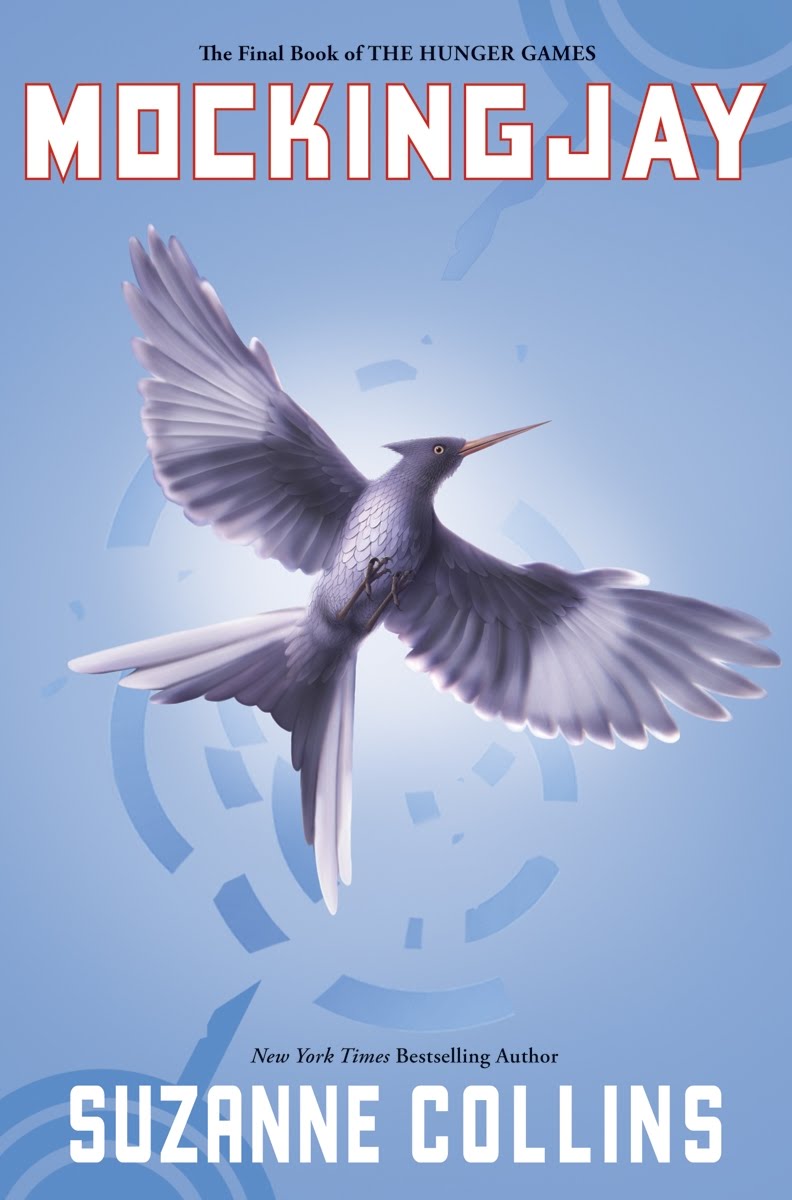
Mockingjay by Suzanne Collins

(Cover picture courtesy of The Book Smugglers.)

Katniss Everdeen, girl on fire, has survived, even through her home has been destroyed.  Gale has escaped.  Katniss’s family is safe.  Peeta has been captured by the Capitol.  District 13 really does exist.  There are rebels.  There are new leaders.  A revolution is unfolding.

It is by design that Katniss was rescued from the arena in the cruel and haunting Quarter Quell, and it is by design that she has long been part of the revolution without knowing it.  District 13 has come out of the shadows and is plotting to overthrow the Capitol.  Everyone, it seems, has had a hand in the carefully laid plans—except Katniss.

The success of the rebellion hinges on Katniss’s willingness to be a pawn, to accept responsibility for countless lives, and to change the course of the future of Panem.  To do this, she must put aside her feelings of anger and distrust.  She must become the rebels’ Mockingjay—no matter what the personal cost.

I loved the Hunger Games trilogy up until this last book.  I wish it could have ended better, but it didn’t.

In Mockingjay, Katniss has transitioned from a strong, independent-minded protagonist to an annoying, whiny narrator.  All she really does throughout the novel is watch District 13 fight the Capitol and moan about how they’re using her as their symbol.  She dodges training sessions, which explains why the rebels are annoyed at her all of the time.  Katniss also angsts about how the rebels are using her, which I find annoying.  If you’re trying to overthrow an evil empire, which is more important: your independence or winning the war?  And if it takes being used to win, isn’t that worth it?

This might just be me, but I found the ending rather disappointing.  As if to demonstrate the total senselessness of war, Suzanne Collins kills of 90% of the characters we meet.  I can understand some deaths (after all, it is a war), but I don’t like how she killed off almost everyone, then wrote a ‘happy’ epilogue to stop her readers from tearing her to shreds.  To me, it’s reminiscent of how JK Rowling ended the Harry Potter series, then wrote a poorly-written hurried epilogue to placate her readers.

In some ways, I wish The Hunger Games had been a stand-alone novel.  What do you think?  Were you satisfied with the ending?  Or did it feel forced?  Please tell me in the comments below.

I give this book 2/5 stars.

Amazon     Barnes and Noble

Some Thoughts on the YA Genre

Today I’m taking a break from book reviews so I can post this.  But don’t worry, the daily reviews will continue running regularly on Friday again.

1)     It isn’t only limited to teenagers.

Both tweens and adults read YA fiction as well as teenagers because some of its themes are universal: love, belonging and trust, to name a few.  I mean, how many adults do you see reading Twilight, The Hunger Games or Harry Potter?  A fair few adults read YA fiction because if it is written well, it can be enjoyed on many different levels.

2)    When it’s bad, it’s really bad.  Conversely, when it’s good, it’s really good.

YA fiction, to me at least, can be a genre of extremes.  It is usually really good or really bad, with very few books falling in shades of grey.  Of course, there are exceptions to this rule.  When a YA book is bad, it goes the whole nine yards: poor writing, one dimensional characters, a slow plot, you name it.  But when a YA book is good it has excellent writing, three dimensional characters and an interesting plot.

3)     It has so much romance!

Pretty much every single YA book I’ve read has had romance in it.  But then, it sort of makes sense because teenagers deal with romance in their daily lives.  Romance isn’t by nature bad (far from it), but it can get tiresome, especially when I read a book that focuses heavily on the romance while neglecting characterization, plot and world-building.  Maybe this is just me, though.

4)     It can be life-changing.

Books were no doubt my greatest influence.  They brought me to new, exciting worlds; helped me escape into the skin of a braver character; taught me things I never would have known otherwise and most of all, gave me a more well-rounded view of life.  When I was being bullied for being an above-average student (among other things), I could read Artemis Fowl and feel empowered.  When I was fighting with my weight, I would read Uglies and feel good about myself.  So many books have changed my life that it would take forever to list them all.  Good YA fiction can help teenagers learn more about life, which is why I wish they would cover more of it in school.  It would keep more people engaged than reading and over-analyzing Shakespeare or Chaucer.

5)     It is one of the fastest-growing genres.

There are more YA books than ever out there!  People have finally realized that teens actually, you know, like to read.  The market for YA fiction is growing, as demonstrated by big publishers like Harlequin, Simon & Schuster and many, many more running specialized teen lines.  This, of course, goes along with the general trend of marketing to tweens and teens specifically. But hey, at least teens are finally having a voice in literature that’s not about to go away any time soon.

These are just five things I’ve noticed about the YA genre in general.  What have you noticed about the YA genre?  Is its expansion a good thing?  What are your favourite YA books?

Catching Fire by Suzanne Collins

(Cover picture courtesy of Suzanne Collin’s website.)

Against all odds, Katniss has won the Hunger Games.  She and fellow District 12 tribute Peeta Mellark are miraculously still alive.  Katniss should be relieved, happy even.  After all, she has returned to her family and her longtime friend Gale.  Yet nothing is as Katniss wishes it to be.  Gale holds her at an icy distance.  Peeta has turned his back on her completely.  And there are whispers of a rebellion against the Capitol—a rebellion that Katniss and Peeta may have helped create.

Much to her shock, Katniss has fueled an unrest she’s afraid she cannot stop.  And what scares her even more is that she’s not entirely convinced she should try.  As time draws near for Katniss and Peeta to visit the districts on the Capitol’s cruel Victory Tour, the stakes are higher than ever.  If they can’t prove, without a shadow of a doubt, that they are lost in their love for each other the consequences will be horrifying.

In Catching Fire, the second novel of the Hunger Games trilogy, Suzanne Collins continues the story of Katniss Everdeen, testing her more than ever before…and surprising readers at every turn.

Catching Fire is the second book in the Hunger Games trilogy, and, like most second books, it is not nearly as good as the first book.  Don’t get me wrong—Catching Fire is still a decent novel in its own right.  But in the context of the series, it is not as good as the first book.

In Catching Fire, Suzanne Collins has broken her own rules (although there is a good reason for it) and centred it on the worst aspect of the first book: the romance.  Throughout the novel, Katniss seems to grow more found of Peeta, but she is hot and cold about it.  One minute, she ‘loves’ him, the next she hates him.  I understand that his happens in real life, but fiction is supposed to make sense and being stuck in Katniss’s point of view makes it very frustrating.

Katniss was a very strong female protagonist in The Hunger Games—and she still is in Catching Fire—but she does not change very much throughout the course of the novel.  The other characters like Peeta and Haymitch do get more backstory and change a bit, but Katniss remains static.  There is, however, a significant amount of development in Finnick, a minor character who suddenly gets a very interesting backstory.  If only Suzanne Collins had developed Katniss like she developed her minor characters in this novel.

I give this book 3/5 stars.

Amazon     Barnes and Noble

The Twelfth Transforming by Pauline Gedge

(Cover picture courtesy of Teen Ink.)

Akhenaten…the powerful, the pious, the infamous.  Raised in the heat of the palace harem, mated to his beautiful, dangerous cousin Nefertiti, the young Pharaoh soon turned his passion heavenward.  His love of the sun god Ra seared his being and consumed his worldly attentions.  As Akhenaten’s rule soared to its finale, ancient Egypt teetered on the edge of a cataclysm, and his family’s curse became an empire’s downfall.

Pauline Gedge is one of the best writers of historical fiction set in ancient Egypt and The Twelfth Transforming proves it.

Set in the (in)famous 18th Dynasty of Egypt, this novel chronicles the entirety of the heretic pharaoh Akhenaten’s reign through the eyes of his domineering mother, Queen Tiye.  Tiye is a ruthless woman by virtue of being Great Royal Wife to pharaoh Amunhotep III (Akhenaten’s father), and as such, is not always a sympathetic narrator.  But she is so three dimensional that she commands your attention and you miss her forceful personality near the end of the novel when she dies.

Pauline Gedge paints a vivid picture of the 18th Dynasty and fills her novel with authentic historical details.  Most of the events in the novel are correct, however there are gaps in history that she fills with the most salacious and dramatic explanations.  But readers also have to keep in mind that The Twelfth Transforming was written in 1984 and reflects the information she had available at the time.  If you do not mind tiny historical inaccuracies (most of which are only noticeable to fanatics like myself), then this is certainly the novel for you.

I give this book 4/5 stars.

Amazon     Barnes and Noble