
Tagged: masq1
Emperor: The Field of Swords by Conn Iggulden
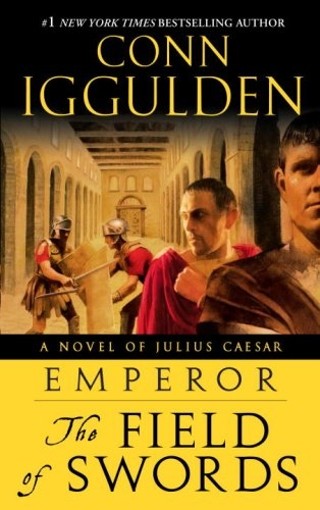 (Cover picture courtesy of GetGlue.)
For Julius Caesar, the time has come to enter the political battleground that has become Rome. Having proved his valor in the slaves’ revolt, Caesar is strengthened by the love of a beautiful older woman—and by the sword of his loyal friend Marcus Brutus. But it is Caesar’s next move that will change history. With an army made in his own image, Caesar begins a daring charge through Gaul, across the English Channel, and to the wilds of tribal Britain.
Here, in a series of cataclysmic clashes, the legend of Julius Caesar will be forged. And while Caesar and Brutus battle the armies of the wilderness, their political adversaries in Rome grow ever more powerful. For when the fighting is over, the greatest danger to Julius Caesar will await him on the Tiber—with a man who wants Rome himself.
The Field of Swords is truly riveting historical fiction of the first order and Conn Iggulden managed to write it without changing history around as much. Surprisingly, the third book in his Emperor series is my favourite out of all four because it is by far the most exciting in terms of plot and character development. It covers the most famous part of Caesar’s life: the Gallic Wars.
War is one of my favourite parts of historical fiction because of all the details of ancient warfare fascinate me. History textbooks do not even begin to cover how physically, mentally and emotionally draining it was on the men and those who had to lead them. Warfare was not a glorious event and Iggulden perfectly hammers this point home.
I absolutely love the character development in this book. Caesar becomes more independent as all of his old tutors and friends die off, leaving him with Brutus as his only friend. How could his only friend orchestrate Caesar’s death? Well, there is a very telling scene near the end of the book when Caesar suffers from an epileptic fit and is unable to lead his men in battle. Brutus dons Caesar’s armour and leads his men into battle.
“You led them?” Julius said. Though his voice was strengthening, he still seemed confused.
“No Julius. They followed you.”
Thus the seeds of jealousy were planted in Brutus’ heart.
I give this book 4.5/5 stars.
The Hitchhiker’s Guide to the Galaxy by Douglas Adams
 (Cover picture courtesy of That’s 2 For The Books.)
On 12 October 1979 the most remarkable book ever to come out of the great publishing corporations of Ursa Minor (and Earth) was made available to humanity – The Hitchhiker’s Guide to the Galaxy.
It’s an ordinary Thursday lunchtime for Arthur Dent until his house gets demolished. The Earth follows shortly afterwards, to make way for a new hyperspace bypass. And his best friend just announced that he’s an alien. At this moment, they’re hurtling through space with nothing but their towels and an innocuous-looking book inscribed with the big, friendly words: DON’T PANIC.
The weekend has only just begun…
At first, I hated this book. But then about halfway through, I finally caught on to Douglas Adams’ fantastic sense of humour. Yes, I’m ashamed it took me that long to catch on, but now I can honestly say The Hitchhiker’s Guide to the Galaxy is unlike any other book I have read before. It’s ironic, witty and it subtly pokes fun at a lot of science fiction clichés.
Aside from being laugh-out-loud funny in spots, the plot moves along quite nicely. The book is only a little over 100 pages, yet more happens in those 100 pages than in the over 700 pages of Brisingr. Douglas Adams’ easy to read, pared down style is a truly refreshing break from the exhausting descriptions of most sci-fi/fantasy novels. His dialogue is also what sets him apart; I read it aloud and it actually sounded how real people speak.
Of course my favourite part of the novel was the unforgettable characters. Ford Perfect, Zaphod Beeblebrox, Slartibartifast and many others are very memorable and will never truly leave you. They’re quirky, unique and, at times, utterly hilarious, which is what makes them stand out so much. The characters are just one of the many reasons to read this great novel.
I give this book 5/5 stars.
The Lightning Thief by Rick Riordan
 (Cover picture courtesy of Rick Riordan’s website.)
Percy Jackson is about to be kicked out of boarding school…again. And that’s the least of his troubles. Lately, mythological monsters and the gods of Mount Olympus seem to be walking straight out of the pages of Percy’s Greek mythology textbook and into his life. And worse, he’s angered a few of them. Zeus’s master lightning bolt has been stolen, and Percy is the prime suspect.
Now Percy and his friends have just ten days to find and return Zeus’s stolen property and bring peace to a warring Mount Olympus. But to succeed on his quest, Percy will have to do more than catch the true thief: he must come to terms with the father who abandoned him; solve the riddle of the Oracle, which warns him of betrayal by a friend; and unravel a treachery more powerful than the gods themselves.
You’ve probably heard this before, but The Lightning Thief has a very Harry Potter-esque feel. It’s not quite on the same level, but it is a very good book. What I like most about it is that it can be read by teenage boys, who are extremely under-represented in the YA genre. Rick Riordan has tapped into this market and I hope more authors will follow his lead and write for boys, who actually do read.
With just the right amount of action and tension, The Lightning Thief is a worthwhile read. Percy Jackson is a very sympathetic protagonist and I love the fact that the series is told by him in first person, which brings us closer to him. Despite being half-god, he is not all-powerful and often needs to be rescued by his companions as he journeys across the country to find Zeus’s lightning bolt. But he is not entirely helpless either, which stops him from becoming an annoyingly incompetent character.
Even if you don’t know much about Greek mythology, you will get a lot out of this book. Rick Riordan has obviously done his research and I love the personality quirks of the gods we meet along the way, especially Mars. If there was only one reason to read this book, it would be because of the gods.
I give this book 4.5/5 stars.
Brisingr by Christopher Paolini
 (Cover picture courtesy of Children’s Books.)
Oaths sworn…
Loyalties tested…
Forces collide.
It’s been only months since Eragon first uttered “brisingr,” an ancient language term for fire. Since then, he’s not only learned to create magic with words—he’s been challenged to his very core. Following the colossal battle against the Empire’s warriors on the Burning Plains, Eragon and his dragon, Saphira, have narrowly escaped with their lives. Still, there is more adventure at hand for the Rider and his dragon, as Eragon finds himself bound by a tangle of promises he may not be able to keep.
First is Eragon’s oath to his cousin, Roran: to help rescue Roran’s beloved from King Galbatorix’s clutches. But Eragon owes his loyalty to others, too. The Varden are in desperate need of his talents and strength—as are the elves and dwarves. When unrest claims the rebels and danger strikes from every corner, Eragon must make choices—choices that will take him across the Empire and beyond, choices that may lead to unimagined sacrifice.
Eragon is the greatest hope to rid the land of tyranny. Can this once simple farm boy unite the rebel forces and defeat the king?
Okay, I have to admit that after I read Brisingr, I began to question Christopher Paolini’s writing abilities. The plot is so slow it’s almost non-existent, the characters are cardboard cut-outs and not much actually happens to get the Varden closer to Galbatorix. I honestly wish I had never read the series past Eragon.
The book starts out interestingly enough: Eragon and Roran are scouting out Helgrind to see where the Ra’zac are. But the plot slows down immediately after they rescue Katrina and Eragon stays behind to kill the last Ra’zac and figure out what to do with Sloan (who betrayed Carvahall to the Empire). He finds a way to help Sloan but make sure that he can never get in the way of Roran and Katrina again.
Then he spends many chapters travelling with Arya, who somehow manages to find him. I wouldn’t mind the fact that he got to travel with his love interest except for the fact that nothing happens between them. I won’t give anything more away, but let me say that the plot of Brisingr is basically the same as the first two books: Eragon travels, learns magic, pines for Arya, then a battle is thrown in at the end of the book to keep readers hooked. Christopher Paolini also throws in an apology at the back of the book for getting his fans’ hopes up about Brisingr being the last book. Then three years later, we get Inheritance, the actual ‘last book.’ But it has an open ending that leaves the potential for a fifth book open.
Despite all of his newfound power and strength, Eragon does not change much throughout Brisingr. He still pines for Arya and acts like a love-stricken child around her. Many characters do not change, but the few that do go completely out into left field. Nasuada, for example, begins treating King Orrin (her benefactor) rudely and bestows a completely unjust punishment on Roran to ‘keep discipline’ among the Varden, never mind that such a punishment would kill a normal human. A leader that relies on blind obedience and punishes initiative will end up like Pompey the Great did during the civil war with Caesar: an army near mutiny that will abandon you as soon as things start going badly. But of course this never happens to the Varden because that would be inconvenient for Christopher Paolini.
I give this book 1/5 stars.
Emperor: The Death of Kings by Conn Iggulden
 (Cover picture courtesy of Barnes and Noble.)
In a sparsely settled region of North Africa, a band of disheveled soldiers turn their eyes toward one man among them: their leader, Julius Caesar. The soldiers are Roman legionaries. And their quarry is a band of pirates who dared to kidnap Julius Caesar for ransom. Now, as Caesar exacts his revenge and builds a legend far from Rome, his friend Marcus Brutus is fighting battles of another sort, rising to power in the wake of the assassination of a dictator. Once, Brutus and Caesar were as close as brothers, devoted to the same ideals and attracted to the same forbidden woman. Now they will be united again by a shock wave from the north, where a gladiator named Spartacus is building an army of seventy thousand slaves—to fight a cataclysmic battle against Rome itself.
In The Death of Kings, Conn Iggulden has managed to simultaneously thrill and annoy me. He thrills me with his wonderful writing, the characters he brings to life and his fast-paced plot, yet he manages to annoy me in his usual fashion when he changes major historical events to suit his narrative. But before I start ranting, let me list the many reasons to read this novel.
It is mostly historically accurate and Iggulden excels in bringing near-mythical figures like Caesar, Sulla, Marius, Pompey and Cato the Younger to life. In their own time they were the leading men of Rome, but they had not achieved the legendary status they have today. Iggulden takes that into account as he develops these characters that are not much different than you or I. They love, lust, fight, cry, rejoice and, most importantly, have doubts about their abilities or if they are fighting for a worthy cause. One of my favourite characters (aside from Caesar himself) is Marius because he had always been a larger than life figure in my mind before Iggulden made him more human.
The Death of Kings is definitely more fast-paced than the first book because Caesar is grown up, more involved in politics and plays an active part in many battles that were going on at the time. There’s also an interesting subplot featuring Cornelia (his first wife) and Sulla that Iggulden uses to kill off the Dictator. We also see more of Brutus, who is a very strong, but fatally flawed character. These two subplots do not take away from all of the action and instead are used to bring the plot forward, which is why I love them.
But, as regular readers will know, Conn Iggulden annoys me because he sees fit to mess with history. He kills off Sulla and Cato, both of whom died many years after the events of The Death of Kings. In Iggulden’s novel, Sulla is poisoned when in fact he died of old age after retiring from the office of Dictator. Cato publicly commits suicide to avoid execution just before Pompey and Caesar go to put down Spartacus’s rebellion. Cato really did commit suicide, but it was not until after the battle of Pharsalus when Caesar finally defeated Pompey after a bitter civil war. In my opinion, killing off Cato so early denied us a look at the dour senator who was always a thorn in Caesar’s side.
I give this book 4/5 stars.