
Category: Book Review
The Savage Damsel and the Dwarf by Gerald Morris
 (Cover picture courtesy of Rainbow Resource Center.)
“A lady,” the dwarf repeated. “I’ve just been disarmed and taken prisoner by a lady.” He shook his head slowly. “I really am pathetic.”
Lady Lynet’s life has become unbearable: Her castle is besieged by an evil knight who beheads her would-be rescuers. Her only chance for freedom is to ask King Arthur for help. But to do so, first she must get to Camelot. So one night she slips away and meets a dwarf named Roger. He doesn’t appear to be the most likely companion, but Lady Lynet soon learns that people can be more than they seem, including herself.
For those of you hoping Book 3 of The Squire’s Tales would contain more about the adventures of Terence and Sir Gawain, you’ll be sadly disappointed. Both Terence and Gawain do appear at various points throughout the novel, but the main focus is on Lady Lynet. This was disappointing for me at first, but then Lady Lynet became such a strong character I had no choice but to connect with her.
Although I know the basic story of Beaumains I really did not see the twist coming at the end. Wow. And it actually made sense, but was surprising at the same time! Gerald Morris also added much more depth to the original legend, most importantly in the case of Roger the dwarf and Lynet. Lynet isn’t just a nagging woman who constantly torments poor Beaumains and Roger the dwarf isn’t just comic relief.
The plot went a little more quickly this time, but that’s probably because we were introduced to the conflict right off the bat: evil knight keeping beautiful damsel captive and killing all knights who try to rescue her until she agrees to marry him. This time the beautiful damsel is not-so-nice and it is her sister, Lynet, who decides to do something to stop the bloodbath. The Savage Damsel and the Dwarf isn’t so much plot driven as character driven. You would think that would make it slow and boring, but the characters are so vivid and the world-building Gerald Morris did was incredible so it worked in this case.
I give this book 5/5 stars.
“The Infinity Ring: Divide and Conquer” by Carrie Ryan
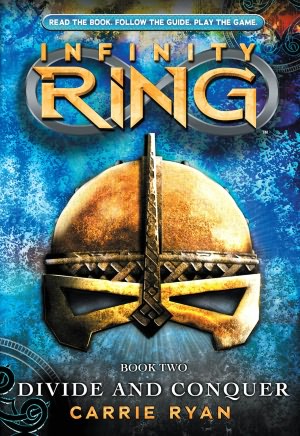 Two weeks ago I posted a review on the first book in The Infinity Ring series and it just so happens that when that review was posted the second book, Divide and Conquer was mere days away from release. Of course that meant that I was going to grab it as soon as it was available and use it for my next review here on The Mad Reviewer.
I was excited to read this book because I am in love with the entire concept behind the series as it currently stands. However, I was a little concerned about how things would go switching to a new author for this installment. I really shouldn’t have worried though, Carrie Ryan takes the characters, personality traits, and little things that James Dashner put forth in the first book and carries them seamlessly into this one as well. As a matter of fact, it was so incredibly seamless that I don’t know if I would be able to pick out which book was written by which author if I was to do a blind test on them while reading. I think that bodes incredibly well for the series moving forward.
Dak and Sera fixed a break involving Christopher Columbus in the first book, and now they are tasked with fixing a break surrounding the viking invasion of Paris in the year 885. Talk about a different type of situation in all regards. For most of the book Dak is separated from Sera and Riq in some fashion because of his innate ability to not think before he does something. This flaw in Dak did wear my patience a little thin at times because it became predictable. They children would solve one problem, get things back on track with their plan, and then you knew a mile away that Dak was going to simply leave the group unannounced and mess everything up again. It must have happened at least half a dozen times in this book. If there is one thing I hope the next author improves upon with the series it is finding a new flaw for Dak because this one has been beat to death.
I was pleased overall with how the characters grew up just a little bit in this installment. They had to make some tougher decisions this time around in deciding how to go about fixing the break in time. They also had to deal with some unintended consequences as they jump from one time period to the next to re-fix a break they broke again on accident. Crazy, eh?
The next book in The Infinity Ring series will arrive this coming February and I must say, I’m rather excited for when it does. It appears as though after dealing with Christopher Columbus and Paris-invading vikings, Dak and Sera will be jumping into the fray with the Underground Railroad during the Civil War. That should be quite interesting.
Grade: B
Length: 192 pages
The Eleventh Plague by Jeff Hirsch
Today I’m guest posting over at Steam Trains and Ghosts for Margaret. I reviewed a post apocalyptic novel that has a male protagonist but no zombies. How is that possible? Well, go on and check it out here! And while you’re there, check out the rest of Margaret’s site for a healthy dose of steampunk.
Antares and the Zodiac by J and L Wells
 (Cover picture courtesy of this site that will not load.)
Four friends, Daz, Eve, Oli and Ebony, meet at a fairground, but what appears to be an ordinary bonfire night couldn’t be further from the truth.
One fairground ride throws them into a very different dimension, where they set off on an incredible adventure that is completely out of this world.
Follow them as they embark on an amazing journey through the star signs of the zodiac.
(Summary courtesy of J & L Wells’ website.)
[Full disclsoure: J & L Wells sent me a free ebook in exchange for an honest review.]
Antares and the Zodiac had such a great premise, but it lacked two things: maturity and a good editor. I’ll deal with the former first.
Much like with The Outsiders, you can tell the authors are really, really young. There’s absolutely nothing wrong with being young and there are a few brilliant young authors, but J&L Wells’ youth really shows in their writing. They lack the experience that comes with age to pull off emotional scenes and they lack the writing experience to pull off what could be very compelling descriptions of the novel’s setting. I’m not saying that there aren’t good parts to the novel (because there are), it’s just that they are overshadowed by the teenage writing style, especially when phrases like this crop up in scenes that are supposed to be suspenseful:
“However, he was forced to eat his words for a second time as things were about to go from bad to worse … MUCH WORSE!” (Pg 132)
Now the latter: this book needed a good editor. How can I say that with absolute certainty? Well, as I read I made notes to myself and here are the numbers that I came up with:
- Capital letters were USED LIKE THIS to emphasize points 92 times.
- Multiple punctuation (as in !!! or !!) was used 16 times.
- ‘duck’, ‘ducky’ or ‘duckies’ was used 225 times.
Note that this all occurs in 255 pages. The use of various forms of ‘duck’ occurs mainly when one character, Daz, is speaking. Character quirks like favourite phrases are important parts of characterization, but when they are used too frequently it just becomes silly. Capital letters should rarely, if ever, be used in novels for emphasizing words—that’s what italics are for. Multiple exclamation points look rather silly, especially if the author(s) are fond of using single exclamation points for normal dialogue. Basically, they lose their punch and aren’t nearly as effective as when an author uses exclamation points only a few times throughout the novel.
Daz and Eve are decent enough characters, but Daz kept getting on my nerves. The constant use of ‘duck’ (in all situations, to all people) is grating and coupled with the fact that he constantly goes off seeking trouble in the Zodiac signs…well it didn’t help my overall impression of the novel.
J and L Wells are young writers with so much promise and I hope that with practice and time they reach their full potential.
I give this book 2.5/5 stars.
The Squire, His Knight, and His Lady by Gerald Morris
 (Cover picture courtesy of Booktopia.)
“Either leave this island, or prepare now to do battle.”
“Then I must do battle,” Gawain said.
Squire Terence and Sir Gawain are on another quest, but this time their journey is overshadowed by their ultimate destination—a contest between Sir Gawain and the Green Knight that could easily lead to Gawain’s death.
As they weave their way between the world of men and the Other World, both Gawain and Terence discover much about themselves. Terence learns more about his past and what the future holds for him, and Gawain is forced to confront the true nature of courage and honor.
Next to the legend of Tristan and Isolde, the tale of Sir Gawain and the Green Knight has always been one of my favourite Arthurian legends. So you could say I’m a bit biased in this review because this is exactly the legend Gerald Morris retells in The Squire, His Knight, and His Lady. And what a fitting tribute to such a great legend!
It’s been five years since the first book, which places Terence from age 18-20 and Gawain in his mid twenties. And unlike a lot of young adult books that are focusing on adults, the adults don’t act like children/young adults. They act their age! The Squire’s Tale mainly focused on Gawain instead of Terence (even though it was in his POV), but Book 2 most definitely focuses on Terence. In the first book Gawain was clearly the hero, but in this book Terence really gets his chance to shine. Rescuing Gawain, traveling to the Other World and falling in love…Terence really experiences some great character growth.
Gerald Morris mentions in his Author’s Note that he has drawn heavily on Sir Thomas Malory’s Le Morte d’Arthur, especially in King Arthur’s battle against the Roman Emperor. All of the Arthurian legends I’ve read take place long after the fall of the Roman Empire, but I also don’t see why they can’t take place during the fall, when Rome was losing its grip on its empire. Gerald Morris was brave when he did that and it worked out very well. It also gives the perfect introduction to that central character in every Arthurian legend: Lancelot.
If you’re a hardcore fan of Lancelot or Guinevere, I would advise you not to read this series. Gerald Morris does not exactly paint the two ‘lovers’ in the most flattering light. But at least he justifies it with his writing and King Arthur is given depth when he realizes that his wife does not love him and never will. One of the most touching passages in the entire novel is this one, when Arthur is speaking with Gawain about Guinevere:
“Am I a fool to love her, Gawain?”
“If so, it is a divine foolishness,” Gawain said. (Pg 33)
Ah, the pangs of unrequited love!
I give this book 5/5 stars.