
Category: Book Review
The Squire’s Tale by Gerald Morris
 (Cover picture courtesy of Tower.)
“What is your name?” Morgause whispered fiercely, almost desperately. “You are no ordinary magician.”
“I am a squire,” Terence said.
But he is no ordinary squire, either. Abandoned as a baby at the door of Trevisant the Hermit, young Terence never expects he will be more than the hermit’s servant. Until one day when a stranger shows up—Gawain, a young man destined to become of the most famous knights of King Arthur’s Round Table. As Gawain’s squire, Terence journeys with him to Camelot and what begins as an adventure soon turns into nothing less than a quest to uncover the secrets of his past.
I have loved the legend of King Arthur ever since my English teacher introduced it to me in grade 5. Everyone has heard different versions of the same story, but that’s the beauty of the Arthurian legends: they grow and change with time, as they were meant to. In The Squire’s Tale Gerald Morris takes an interesting approach, as he states in his author’s note. He is “trying to restore the reputation of this most honored of all knights on earth.” It’s not Lancelot, but Gawain, The Maiden’s Knight.
It is not Gawain, but Terence, his squire who tells his story. Terence himself is a great character: the son of unknown parents with the ability to see faeries. He doesn’t seem all that remarkable in the beginning, but Terence goes through a wonderful character arc as he embarks with Gawain upon his quests. To me it is Gawain who steals the show because Gerald Morris’ version of him is similar to that of Rosemary Sutcliff’s (an author I have always admired). However, Terence is the one that readers will most likely sympathize with because this book is aimed at younger teens and tweens and he is very much the voice of adolescent uncertainty.
The plot of The Squire’s Tale moves along quite a bit faster than I’m used to in books incorporating the Arthurian legends, but it suits Gerald Morris’ writing style. There are really no places where the plot sags, not even in the beginning when we are introduced to Terence. The characters are quirky and memorable and there’s plenty of humour to offset some of the serious elements. Overall, a fitting retelling of the Arthurian legends, except for the ending. Gerald Morris kind of stuck Morgause in there at the last minute and I felt that the ending scene was rushed, but it does at least make sense. This is one series I will be continuing.
I give this book 4/5 stars.
Kushiel’s Chosen by Jacqueline Carey
 (Cover picture courtesy of Lusty Reader.)
The land of Terre d’Ange is a place of unsurpassed beauty and grace. The inhabiting race rose from the seed of angels and men, and they live by one simple rule: Love as thou wilt.
Phèdre nó Delaunay was sold into indentured servitude as a child. Her bond was purchased by a nobelman, the first to recognize that she is one pricked by Kushiel’s Dart, chosen to forever experience pain and pleasure as one. He trained Phèdre in the courtly arts and the talents of the bedchamber—and, above all, the ability to observe, remember, and analyze.
When she stumbled upon a plot that threatened the very foundations of her homeland, she gave up almost everything she held dear to save it. She survived, and lived to have others tell her story, and if they embellished the tale with fabric of mythical splendor, they weren’t far off the mark.
The hands of the gods weigh heavily upon Phèdre’s brow, and they are not finished with her. While the young queen who sits upon the throne is well loved by the people, there are those who believe another should wear the crown…and those who escaped the wrath of the mighty are not yet done with their schemes for power and revenge.
While it may disappoint some readers, Kushiel’s Chosen has much less sex and far more political intrigue than Kushiel’s Dart did, which suits me just fine. But hey, each to their own.
The thing I most admire about Jacqueline Carey’s novels is how she weaves mythology and history together to establish Terre d’Ange and all the lands around it. As I mentioned in my review of Kushiel’s Dart, Jacqueline Carey draws on real historical events and combines them with the tale of Elua and his Companions to create an alternate Medieval Europe. To truly appreciate the scope of her world-building it helps to have a background in ancient history, particularly that of ancient Rome. It’s not necessary to understand the books, but it really does enhance your reading experience.
There were a few times I was annoyed at Phèdre for being a Mary Sue, but then I realized something: she is a rarity, the first anguisette in three generations and was the ambassador to Alba for the Queen Ysandre. Of course she’s going to be revered and looked on with curiosity by people. That’s what happens when people achieve legendary status within their own lifetime. Phèdre also goes through a lot more character development, particularly when she’s in Kriti. She’s a lot more aware of her actions and how they affect people and by the end of the novel she’s a better person for it.
The plot of Kushiel’s Chosen is much faster than that of the first book, mainly because we don’t have to go through Phèdre’s childhood again. Instead, we can skip right to the action where she’s trying to figure out where Melisande escaped to and why she sent the sangoire cloak back. The search for Melisande is, of course, more complicated than it seems at first but it really is amazing what Phèdre goes through in order to find her. Hint: Melisande is not hiding where you would expect her to be. In hindsight I probably should have guessed where she was hiding, but I had no idea until the dramatic reveal. In the hands of most authors, a reveal like that would be very cliché, but Jacqueline Carey definitely pulled it off.
I give this book 5/5 stars.
Why Books Should be Rated on a Logarithmic Scale
This is a guest post by Margaret of Steam Trains and Ghosts. Do you think books should be rated on a logarithmic scale? Do you think they should be rated at all?
I don’t like giving books numerical ratings when I review them. There is something unsatisfying about the 1-5 star ratings you can find on Amazon and Goodreads, and I think the problem is that five stars don’t begin to capture the range of literary greatness that is out there. The best book ever is only five times better than the worst book ever? Really? Even rating books on a 1 to 10 scale doesn’t seem like enough.
I think a better way to do things would be to take a lesson from earthquake-prone California. I grew up there, so I learned about earthquake magnitudes along with my ABC’s and how to tie my shoes. Scientists measure earthquakes on a logarithmic scale that goes from 0 to roughly 9.5. “Logarithmic” means that a 5 on this scale is actually 105, a 6 is 106, ten times bigger than a 5, and a 7 is 100 times bigger than a 5, and so on. The scale’s useful because it gives you a big range – from 0 to 1,000,000,000.
Tiny earthquakes happen literally all the time. Every few minutes. We can’t even feel them and we only know they exist because of seismographs. Once an earthquake gets up to about a 4.0 on the scale, it’s starting to rattle dishes in the cabinets. A 6.7 is going to be something like the Northridge earthquake of 1994, which tore up streets in the L.A. area, damaged a lot of houses, and people are still talking about it today. The Great San Francisco Earthquake of 1906, which caused most of the city to burn down, was an 8.0. The largest earthquake ever recorded was a 9.5 in Valdivia, Chile in 1960.
Books are like earthquakes. Hundreds of thousands of little ones pass by without anybody’s notice all the time. Every year or so, a book makes you sit up and go, “What was that?” And every once in a great while, a book knocks you over, rips your socks off, and burns your house down. Well, hopefully not that last part. But anyway, I think that the best books are thousands of times better than the worst books.
So here’s my proposal for a better book rating scale:
1-3) Poorly written. One has the sneaking sense that the author does not have a firm grasp on grammar or punctuation. Plot? What plot? This is a first draft that isn’t ready to show to people yet, but unfortunately, you find these on the Internet all the time.
4-5) Mass-produced stuff. Like those pulpy mystery novels you find sometimes where the author has written 32 other titles. These have a plot and characters but they’re forgettable.
6) This is an okay book. It’s got a decent story, comes to a satisfying ending, and maybe even makes you think about the conventions of the genre. A good example would be Tooth and Claw by Jo Walton. Makes you looks at dragons differently after you read it.
7) The good stuff. These are bestsellers or at the very least extremely strong sellers. Compelling characters, vivid worlds, storylines that challenge the reader. Ursula le Guin and Phillip Pullman belong here.
8) Classic literature. The stuff they make you read in English class. The book may have defined a genre (Tolkien), captured the essence of a way of life (Steinbeck), or added new phrases to the English language (Dickens).
9) Paradise Lost. Seriously. This story tells the story of the history of the entire universe, has the entire population of Heaven, Hell, and Earth as its cast of characters, and pulls the whole thing off in iambic pentameter. And John Milton was blind when he wrote it. Read it and just try to think about Satan the same way ever again.
“The Infinity Ring: A Mutiny in Time” by James Dashner
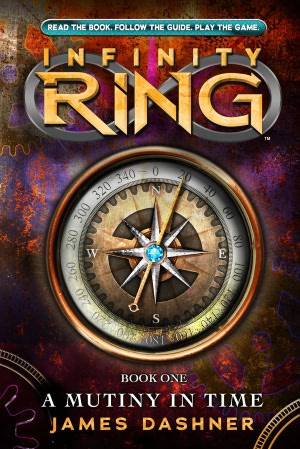 The Infinity Ring: A Mutiny in Time is the first installment in what appears to be a long-term project by several different authors to provide the next big middle-grade book series. The basic concept being that the world all of the characters are living in is actually an alternate reality brought about by many, many well-known historical events not happening the way we remember them. It’s certainly and interesting twist on the usual approach of alternate realities in books. Usually characters are traveling to the alternate reality, not arriving from the alternate reality. I have to say, I loved it through and through.
Dak and Sera are serviceable enough characters for what the story is trying to accomplish and I can entirely understand why they don’t have the depth I’m used to with characters I read because this is a middle-grade series and with a target audience like that you have to keep things a little more simple. There are a few clichés tossed around as far as character personalities are concerned, but nothing glaring and nothing that bothered me all that much.
In this first book of the series the two friends discover The Infinity Ring, a device capable of traveling them through time. Through a series of somewhat unfortunate events they are forced to aid a group known as the Hystorians who are trying to fix all of the wayward big moments in history. Each event has to be righted in a specific order so as to keep the events closer to modern day as unaffected as possible. The first of which that Dak and Sera have to correct is the fact that Columbus was not credited with discovering America.
Back in time the two friends go and as they are younger than your standard adventurers they have plenty of blundered moments that almost leave them stranded in the past. They figure things out in the end however and the result is a fun, quick, exciting tale that takes and interesting approach to time travel and its effects on space-time and all that.
The second installment of The Infinity Ring series, Divide and Conquer was released earlier this week and I look forward to reading it soon and letting all of you know what I think.
Grade: B
Length: 192 pages
Finding Time by Steve Poling
 (Cover picture courtesy of The Independent Author Network Blog.)
Rescue the past to build the future. In 2280 EarthGov is desperate when aliens destroy their first colony. They’ll even comb through the wreckage of the aliens’ UFO that crashed in 1947—where one man claims he’s found a time machine. Now the race is on to scour history for the treasures and talents EarthGov needs.
Sid Feynman just wants a government grant. His hopes for a quiet academic life are dashed when EarthGov thrusts the beautiful historian Nell Playfair upon him and expects Sid to actually use the time machine.
Soon Sid and Nell are rocketing across light-years of interstellar space and millennia of history—seeking that which is lost and finding time.
[Full disclosure: Steve Poling gave me a free ebook in exchange for an honest review.]
Well, that certainly wasn’t what I expected.
That’s a compliment, by the way. Finding Time is a book with many different viewpoints, but Steve Poling handled each of them so well that it was never confusing. The first chapter seems completely unrelated to the rest of the book until later, but when the reason behind the event was revealed it made perfect sense. That’s what made Finding Time so interesting for me: the different narrative threads intertwining perfectly, especially toward the end. I live when things are tied together in a way that makes sense and that is especially important in a time travel story.
I won’t even begin to pretend I understand half of the science behind time travel in this book. Science was never my strong point, but hard science fiction fans will love this book for it. I would have liked the explanations to be “dumbed-down”, but I am not the audience Steve Poling was writing for. Each to their own, really. I’m sure most people will have a better appreciation for his attention to detail than I do.
However, I did appreciate the characters. Nell and Sid were the two main characters and they definitely stood out. Their bickering is priceless, but you can tell that they become good friends by the end. No, they don’t fall in love with each other. Gasp! A male and female lead that don’t fall in love! Call the press! As Steve Poling put it in his initial email to me: “there’s no cussin’, smokin’, or gettin’ nekkid.”
See? It is possible to write a good novel without any of those things! YA writers take note.
I give this book 4.5/5 stars.
*Only available through Amazon in Kindle format.